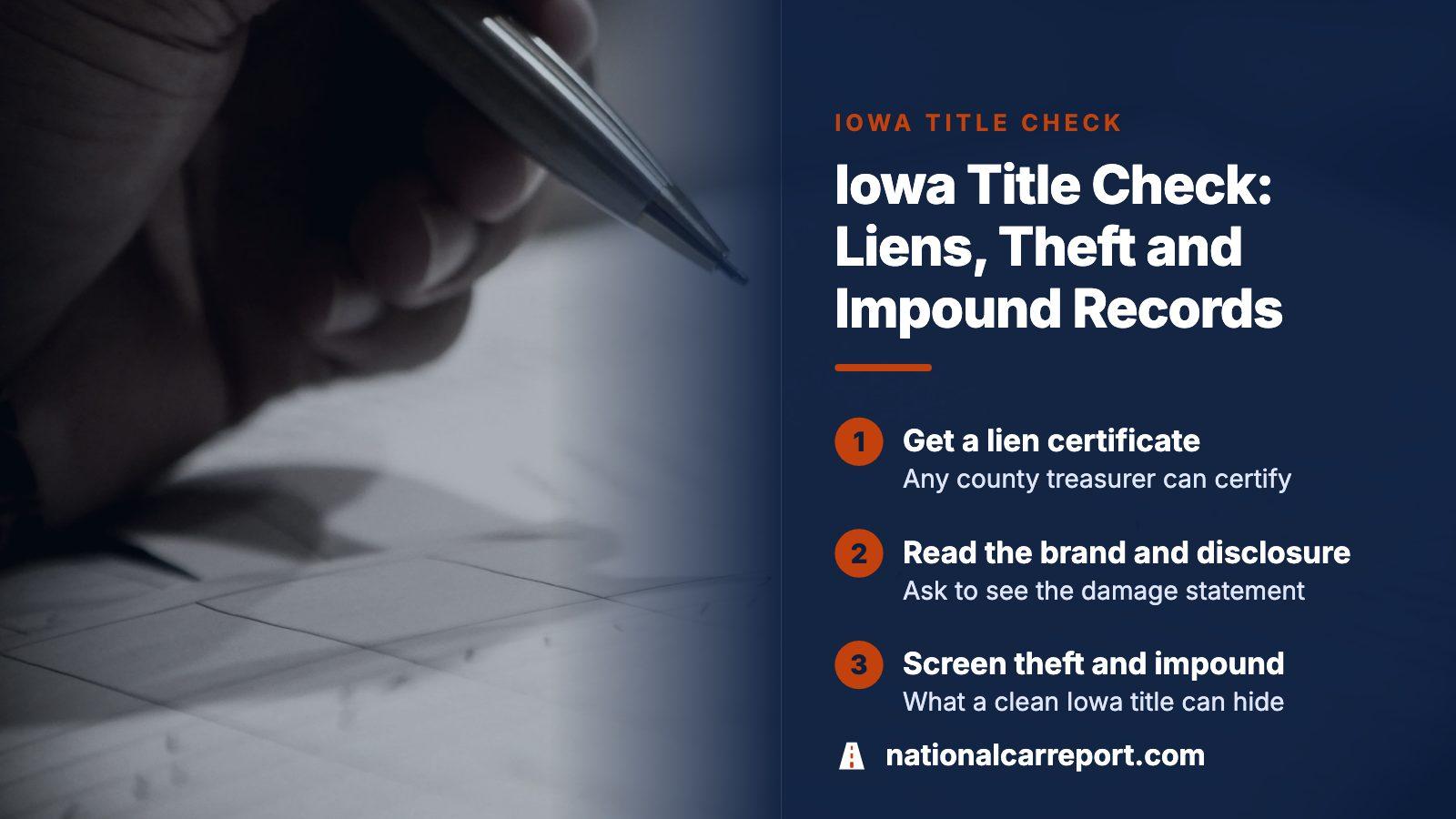
THE SHORT ANSWER
Ask any county treasurer for a lien certificate on the VIN, read the designation and the damage disclosure on the Iowa title, then run the VIN in the preview for theft, impound and salvage records. Outside records matter because an Iowa title usually does not show an open theft report or a tow-lot sale. Finish before paying: the buyer has 30 calendar days from purchase to apply for a new title.
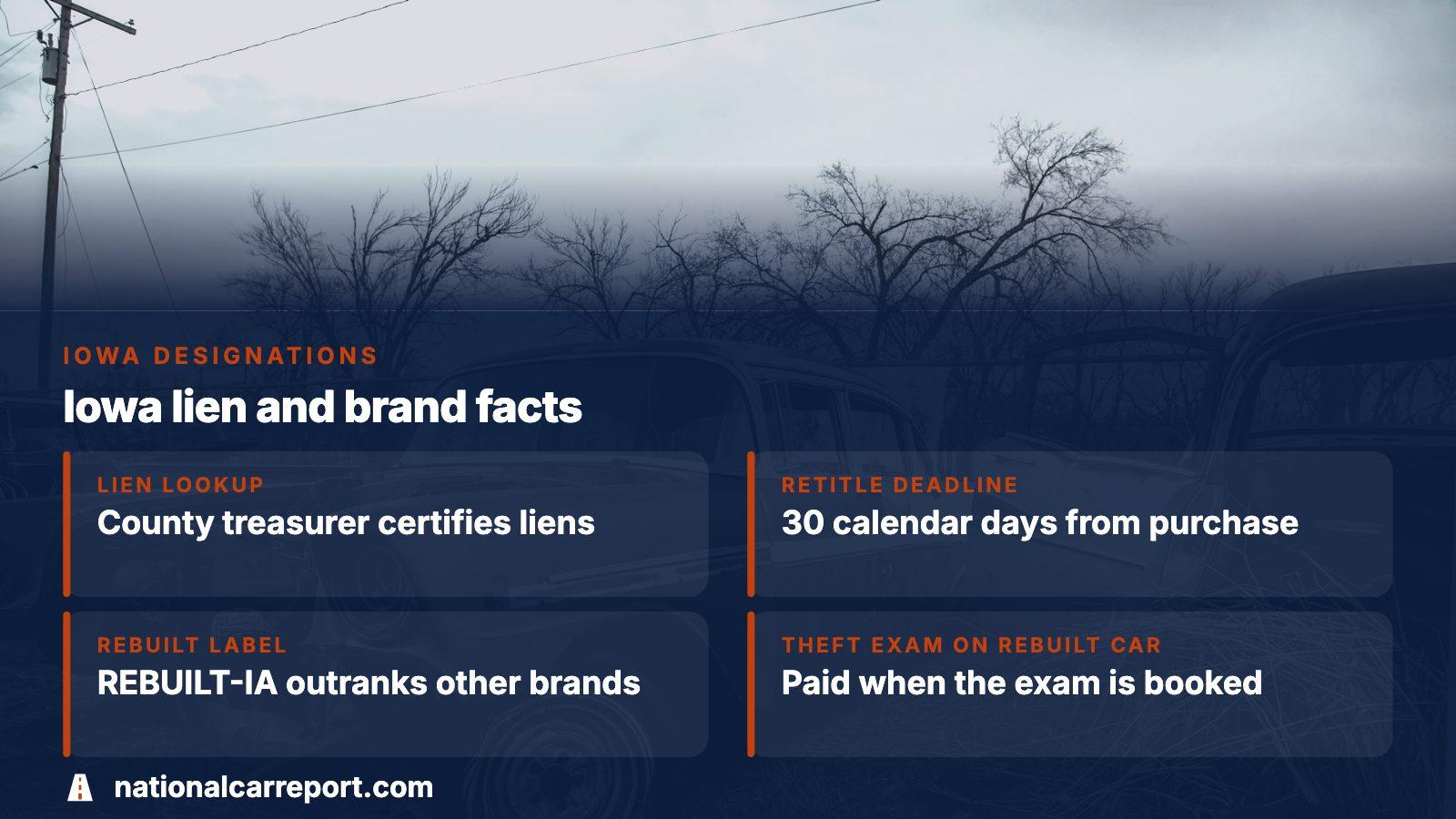
- Lien lookup
- Any county treasurer certifies liens on a vehicle for $2 or $3
- Retitle deadline
- 30 calendar days from purchase
- Title fee
- $30, plus prorated registration
- Officer's theft exam on a rebuilt car
- $50, paid when it is booked
Three questions an Iowa title check has to settle
NationalCarReport reads a car through its liens, its theft record and its impound record, and an Iowa title check begins in the same place. The paper title is a reliable witness on ownership and loans. It says little about police files and tow lots.
- Who is owed money: the title face names each lender and the date its claim was recorded, and up to three can appear.
- What happened to the car: a designation points to damage, a rebuild, or a recovered theft.
- Where it has been held: an impound auction or an unresolved theft leaves traces outside the title.
Start with a lien certificate from the county treasurer
Iowa lets anyone ask a county treasurer to certify, as of a stated date and hour, whether a vehicle carries liens and who holds them. The charge is $2 on a form that meets Secretary of State standards and $3 on any other request, while a certified copy of the recorded interests costs $1 a page. Confirm the current form and fee with the office before you go.
Two details change how you read the answer. A lender that has been paid off clears its claim on the title face, on Form 411168 or on a notarized letter. And a loan recorded electronically means no paper title is printed until the last lien is released, so a seller with no paper in hand may still owe a lender.
Pay the lender, not the promise
Iowa ties a buyer's rights to a title assigned to that buyer. If a payoff is pending, send the money to the lender and keep the written release before the car leaves.
Which record answers which question
| Record | What it settles | What it misses |
|---|---|---|
| Iowa title in the seller's hands | Owner, recorded lenders, designation, odometer marked actual or not actual | Theft reports, tow-lot history, damage the seller never disclosed |
| County treasurer lien certificate | Liens on record at the hour stated, with each lender's address | Brands that other states issued |
| National title record from an approved provider | Brands, latest odometer, insurer total losses, salvage-yard transfers, some theft history | States that do not report, so a clean result can be wrong |
| NICB VINCheck | Flood damage, unrecovered theft and salvage declarations | Lenders and ownership |
| NationalCarReport preview and report | Liens, theft and impound records beside brands and odometer readings | Anything not yet reported to its sources, so the treasurer still decides liens |
| NHTSA recall list | Open safety recalls on the VIN | Title, theft and lien data |
Reading the brand: Iowa designations and the officer's exam
A car counts as wrecked or salvage when repairs would run past 70 percent of its value before the damage. Iowa prints a designation on the title when the past calls for one, and later titles carry it forward.
- SALVAGE: as a rule, repairs and an officer's examination come before a regular title can follow.
- REBUILT-IA: a former Iowa salvage car; this label outranks every other designation.
- Rebuilt followed by two letters: the brand came from another state.
- Other labels: damage over 70 percent, flood, fire, vandalism, a recovered theft, or a manufacturer buy-back.
The exam asks whether the car or its parts were stolen. The statute is explicit that no safety inspection is involved, so passing tells you nothing about repair quality. A brand from elsewhere follows the car in: Iowa copies a rebuilt title as rebuilt and names the issuing state.
The damage disclosure statement: ask to see it
Iowa will not issue a title until the seller has signed a damage disclosure. The seller says whether a salvage, rebuilt or flood title is known to have been issued anywhere and, failing that, whether the car took damage beyond the 70 percent line. It normally sits on the back of the title. A separate sheet is used when no title is in hand at the sale, or when the seller knows of an earlier brand from another state that the Iowa title does not show.
Two consequences follow. The DOT keeps every statement it receives and gives copies to the public on request, so the answer can be pulled later. A seller who skips it leaves the buyer a chore: a sworn statement describing a good-faith effort to reach the seller, plus a buyer-completed form. A model-year formula exempts some vehicles, so ask the treasurer whether yours is covered.
Theft and impound: what a clean Iowa title can hide
A vehicle that police impounded and nobody reclaimed within 10 days can be treated as abandoned. The agency mails a certified notice within 20 days to the last registered owner and each recorded lender, who then have 10 days to pay the towing and storage bill. After that the car can go to auction, and the winning bidder takes it free of liens, holding a sales receipt where the old title would be.
Theft is the mirror image. An insurer that pays out on a car never found must obtain a salvage title within 30 days. The national title system can likewise label a car a total loss after 30 days missing, and the label survives a safe recovery. Cloning is worse: a stolen car wears a VIN copied from a matching vehicle, and Operation Roadrunner recovered about 250 of them.
A sales receipt is a flag, not a verdict
If the paper trail includes an auction receipt or a gap, ask what happened and when, then compare the VIN on the car with every document.
After the check: the 30-day transfer clock
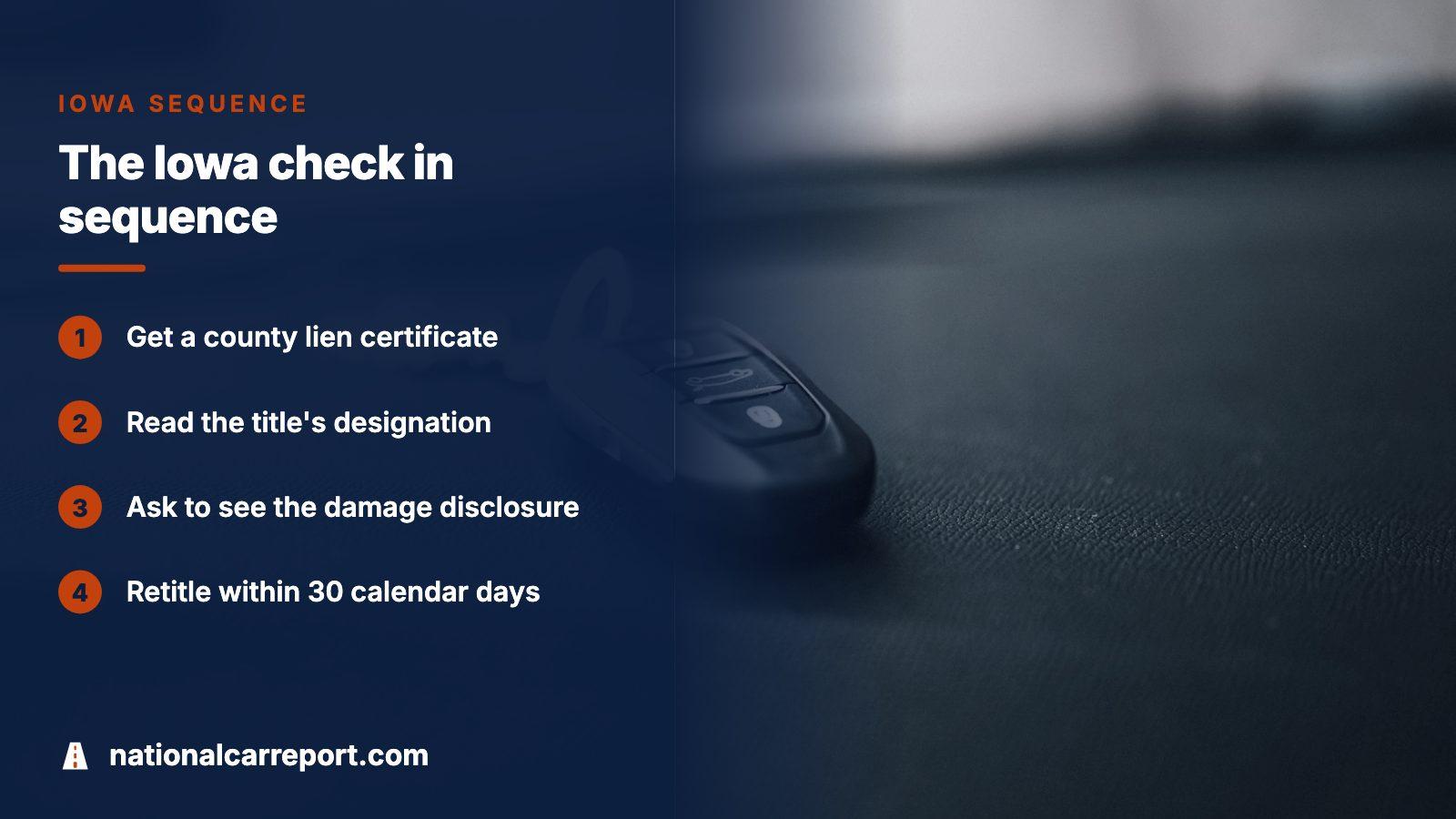
The seller endorses the title with an assignment and warranty of title, lists any liens, and hands it over with the car. From the purchase date the buyer has 30 calendar days to apply at any county treasurer for a new title and registration. The title fee is $30, and annual registration is prorated.
- The seller's signature on the assignment, with liens listed or none.
- The damage disclosure, signed and dated by both sides.
- An odometer statement, because the new title prints the reading as actual, not actual, or beyond the mechanical limits.
- The seller's statement of the county that last registered the car, plus the expiry date.
- Written release paper for any lender that was paid.
What the preview and report cost
Running a VIN through the preview is free, and it shows what comes back before any money changes hands. The full report is bought once with nothing recurring, and pack sizes of 3, 5 and 10 help when several Iowa listings are on your shortlist. Prices live on the pricing page, while the sample report lays out how lien, theft and impound entries appear.
Run the VIN before the deposit, take any lien or theft hit to the treasurer's counter, and walk away from a car whose paper and VIN disagree.
Where this information comes from
- Iowa Code 321.50: security interest provisions — Source for the county treasurer's lien certification, its fees, up to three recorded liens, release rules and electronic liens.
- Iowa Code 321.52: salvage, wrecked and junked vehicles — Source for the 70 percent definition, the officer's theft examination, its fee and the insurer's 30-day salvage title rule.
- Iowa Code 321.69: damage disclosure statement — Explains what the seller must disclose, where it is written and who can get copies.
- Iowa Code 321.89: abandoned vehicles — Covers impounded cars that are not reclaimed, the notice periods and what an auction buyer receives.
- Iowa Code 321.46: new title upon transfer of ownership — Source for the 30-day filing window and the title fee.
- Iowa Administrative Code 761, chapter 405: salvage and other title designations — Lists the designations printed on Iowa titles and how out-of-state brands carry over.
- Department of Justice: NMVTIS for consumers — Describes what the national title system holds, where it falls short, the total-loss label and cloning.
Sources and photos: Facts checked against the sources above in November 2026. Photos by Masjid MABA, Bence Balla-Schottner and Leo_Visions on Unsplash; diagrams by NationalCarReport.
Keep reading
- DMV Lien Release Search: How to Confirm a Lien Is GoneHow to confirm a lender has let go of a car after payoff.
- Stolen Car Check by VIN: Nationwide Theft, Lien and Impound RecordsTheft records for any car, and what a recovery leaves on the file.
- Impound Lookup: Find a Towed Car, Then Check Its VIN for Impound RecordsFinding a car that was towed or held, and what to ask afterward.
- PricingOne report or a pack, paid once, with no subscription.
Frequently asked questions
How do I do an Iowa title search?
Confirm that the number stamped on the car is the number printed on the title. Then ask a county treasurer for a lien certification, read the designation and damage statement, and run the VIN for theft, impound and salvage records. The treasurer settles liens; the VIN search fills in what paper omits.
Is there a free Iowa title check?
Only pieces of one. The preview is free, NHTSA's recall list is free, and NICB's VINCheck screens a VIN for flood, theft and salvage declarations. None of them replaces the treasurer's lien certificate. A full history report is a separate one-time purchase.
How long do I have to title a car I bought in Iowa?
Thirty calendar days from the purchase, at any county treasurer. Bring the title the seller endorsed and the county of last registration with its expiry date. A seller who files an affidavit of sale with a treasurer is presumed to have assigned and delivered the title, which helps if the paperwork stalls.
Can I buy an Iowa car that still has a lien?
Only if the lender is paid at the sale and the release arrives in writing: a cancellation on the title, Form 411168 or a notarized lender letter. A lender that ignores a written request for 15 days owes the payer $25, but that penalty is no substitute for holding the release itself.
What does a rebuilt designation on an Iowa title mean?
REBUILT-IA means the car was once an Iowa salvage vehicle and moved to a regular title, normally after the officer's examination for stolen parts. It is silent on repair quality, so book your own inspection. A rebuilt label with a state code points to another state's brand, which makes a national title record worth running.
Now check the car itself
The guide explains what to look for. The report shows what this VIN has on record.