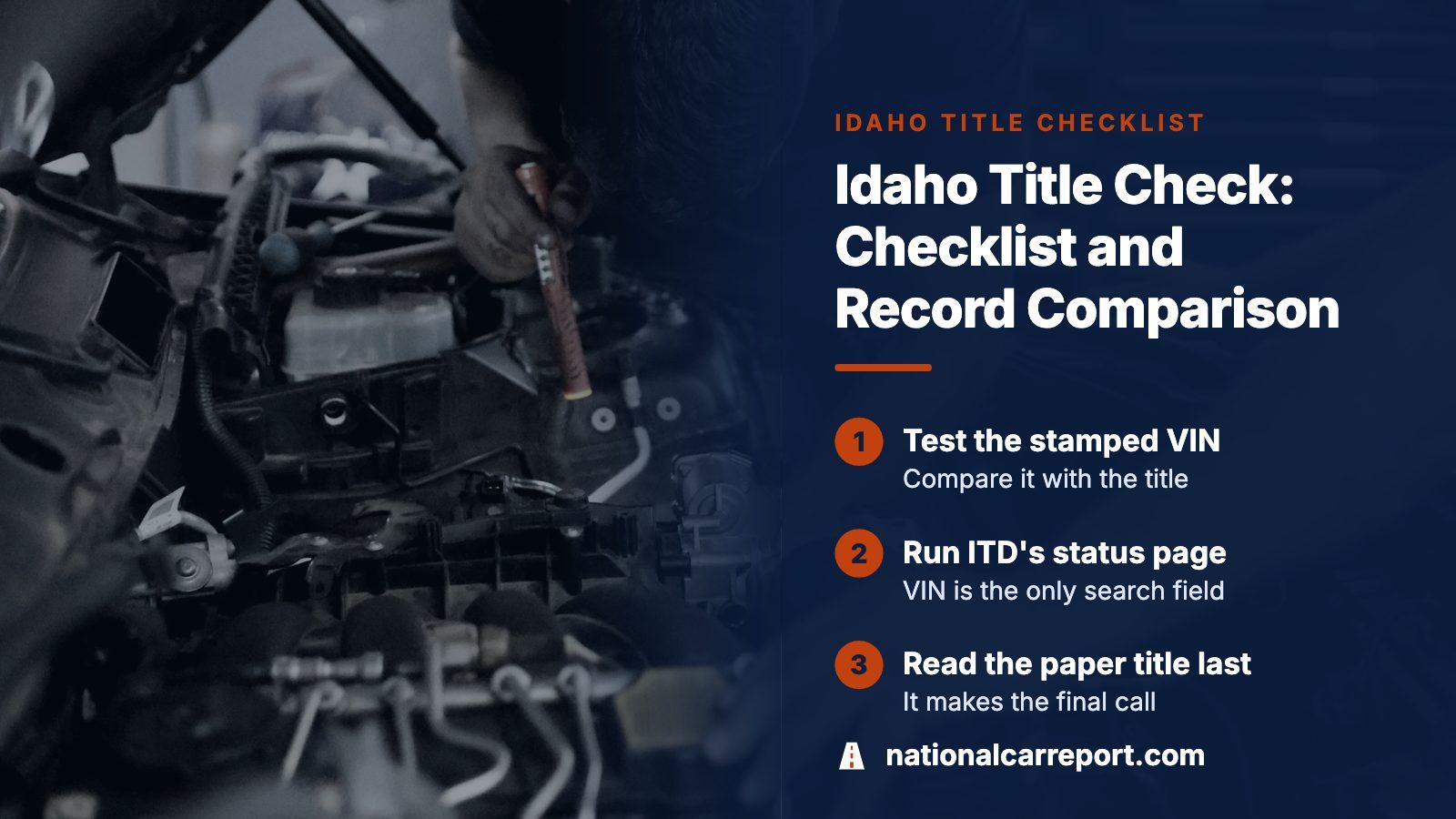
THE SHORT ANSWER
Start with the VIN stamped on the car and test it against the title, then run it through ITD's online status page and the preview to surface brands, liens, theft and impound entries. The paper title makes the final call, since the seller and any lender must have signed off on it. File for the new title within 30 days of the sale.
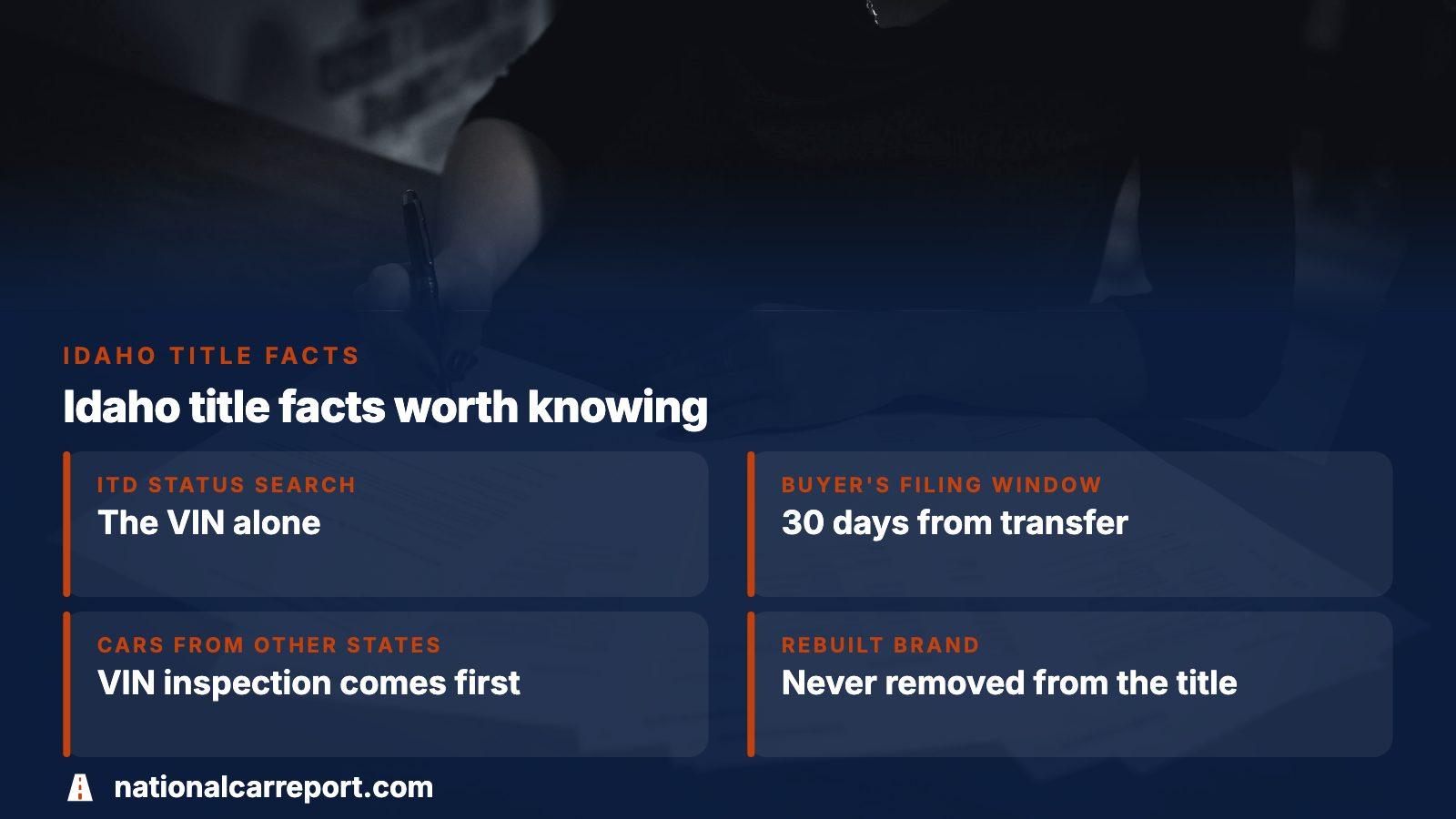
- Search key
- The VIN alone; ITD's status page has no other field
- Buyer's filing window
- 30 days from transfer, then a $20.00 penalty
- Cars from other states
- A VIN inspection comes first
- Rebuilt brand
- Printed under Other Pertinent Data, never removed
What an Idaho title check can and cannot find
NationalCarReport approaches a car through three records: liens, theft reports and impounds. An Idaho title speaks to the first and sometimes carries a brand. It names the owner and any lender, but a theft report filed under a former owner, or a tow yard's claim, sits elsewhere, tied to the VIN.
- Owner: whose name is printed, and who has signed it away
- Brand: Rebuilt Salvage or Theft Recovery wording
- Lender: a recorded stake to clear first
- Theft and tows: other records, found by VIN
Which record answers which question
Each record below has one strength and one blind spot, so pair them.
| Record | Best at | Blind spot |
|---|---|---|
| ITD title status page | Idaho's view of the title, by VIN | Does not list what its answer contains |
| Paper title | Signatures, lender entry, odometer statement, brand wording | Silent on theft reports and tows |
| NMVTIS-approved report | Brands, last odometer, insurer total losses, salvage-yard transfers | Reporting gaps can yield a false clean |
| NICB VIN lookup | Flood, unrecovered theft, salvage declarations | No owner or lender detail |
| NationalCarReport preview and report | Brand, lien, impound and theft entries by VIN | Only as complete as reporting; the paper still decides who can sell |
| Tow company named on a notice | Whether a storage claim exists | ITD describes no public search for buyers |
The checklist to finish before the deposit
Tick these off in order.
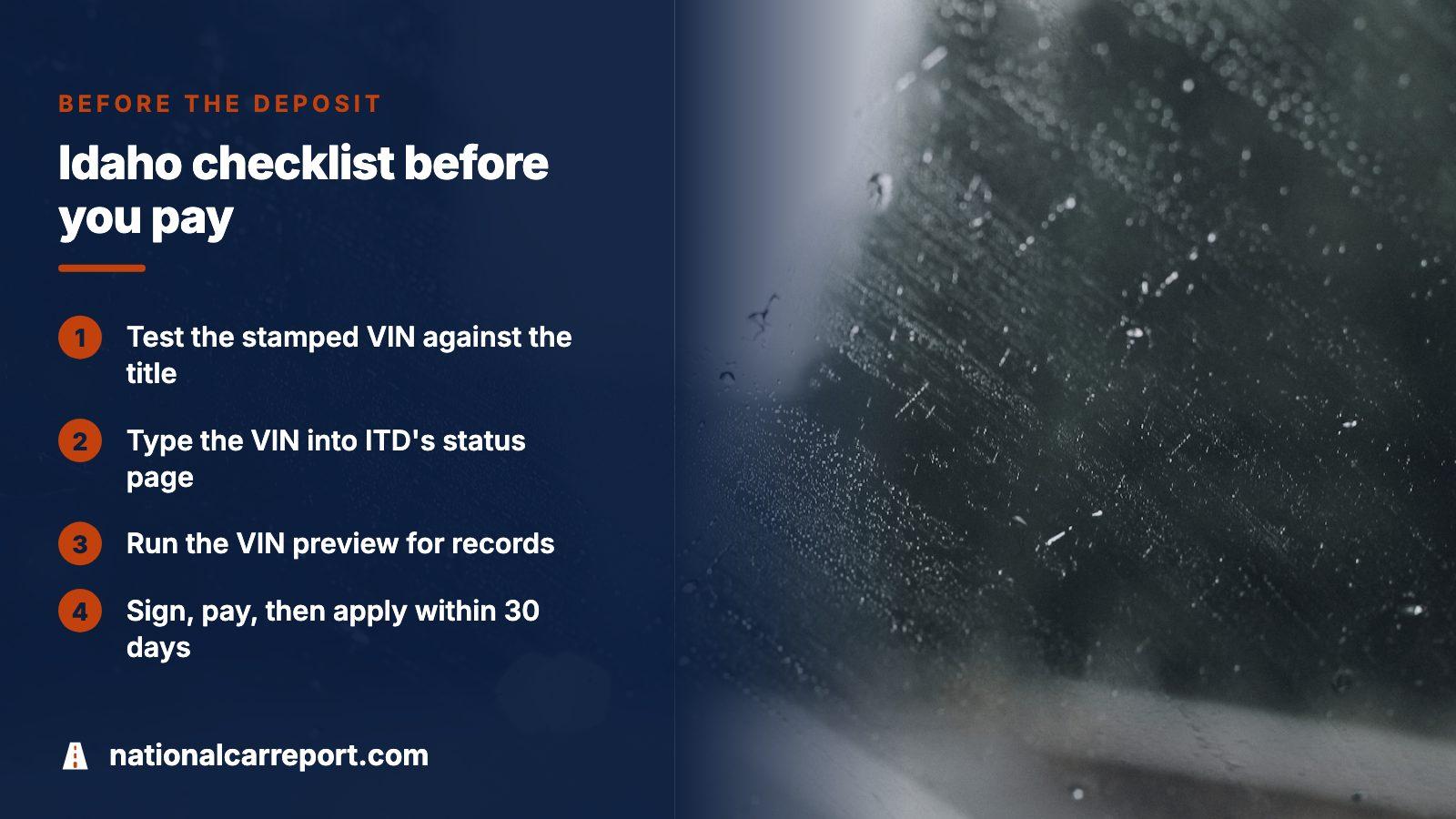
- Locate the number stamped on the car and test it, symbol by symbol, against the title and the listing. A mismatch halts the purchase.
- Type the VIN into ITD's status page. It asks for that number alone, with no title number or plate.
- Run the VIN in the preview for brand, lien, impound and theft entries.
- Add NICB's lookup for flood, unrecovered theft and salvage flags, plus NHTSA's recall list.
- Study the paper title with the seller beside you: owner name, lender box, brand wording, signatures.
- Book an independent mechanic. The FTC is clear that a report cannot stand in for a physical look.
- Sign and pay, then apply for the title inside 30 days.
How Idaho words a damaged or recovered car's title
Idaho casts salvage wide: a salvage certificate or similar paper, an owner or insurer judging repairs uneconomical, or an insurer's total-loss payout each qualifies. The certificate replaces the title, and no registration is possible until a title application is in.
After repairs pass the equipment rules, the title is issued reading Rebuilt Salvage in the Other Pertinent Data box, permanently. Theft Recovery is a separate notation, used when an insurer paid a theft claim and the car resurfaced without salvage-level damage.
Out-of-state brands
A car Idaho titled earlier and another state later declared salvage returns with Rebuilt Salvage or that state's brand carried forward. For cars arriving from elsewhere, the Justice Department notes a brand can vanish when a state skips the origin state's records, so check nationally.
Liens, paperless titles and the seller with no paper
A financed Idaho car has the lender's name and address recorded, and the title travels to the lender, by mail or electronically. Lenders in ITD's electronic program may hold it paperless; that continues until the debt is cleared and the lender requests paper, which ITD mails the following day.
A seller with no title in hand may therefore be waiting on a lender. Ask for the payoff amount, settle it with the lender directly and collect a written release. What reaches you should bear signatures from the prior owner and any lienholder, each giving up their interest.
When the title is truly gone
ITD describes another route using a bill of sale (form 3738) and a Conditional Title Statement of Facts (form 3405), with more steps. Take it slowly, confirm the process with ITD first, and run the VIN again.
Theft and cloned VINs: what the national data adds
Paper can be forged or borrowed. The Justice Department explains cloning: a stolen car is given the VIN of a different vehicle with the same make, model and year. Operation Roadrunner, a South Florida case, recovered roughly 250 such cars. Cloning targets buyers who trust a printed number, so run the theft screen on the VIN you copied from the car.
Two quirks matter when reading a hit. A car unrecovered after 30 days can be recorded as a total loss, and that label survives a later recovery in good condition. In Idaho, a car whose theft claim an insurer paid may show Theft Recovery on its next title.
A VIN mismatch
When the car and the title show different numbers, do not negotiate. Leave, and call the police if the stamping looks altered.
If the car was towed: Idaho's abandoned-vehicle clock
Licensed tow companies report impounded and abandoned vehicles through an ITD portal. Owners may reclaim a car whenever they like, with daily storage fees running meanwhile. ITD's page shows no buyer-facing search, so ask the seller who towed it and whether that bill was paid.
- Within 10 days of the first DMV notice: a hearing can be requested after a police-ordered tow
- Within 20 days: a declaration of opposition can be filed
- After 30 days without a claim: the tow company can seek a title or a junk certificate
A title issued after that process belongs to the tow company, which can then sell the car or send it to scrap to cover its bill. A car sold from a tow lot should come with that title in hand, not a promise of one.
Red flags and the move to make next
| Finding | Possible meaning | Next move |
|---|---|---|
| Title and car show different VINs | A typo, or a swapped or cloned identity | Stop and do not pay; involve police if altered |
| Rebuilt Salvage in Other Pertinent Data | Once declared salvage, then repaired; permanent | Value it as branded; inspect the repairs |
| Lender listed, or seller lacks the paper title | A loan may be open, or the title held electronically | Obtain the lender's written release first |
| Unrecovered theft flag | The car may still be reported stolen | Have police confirm the report's status |
| Tow or impound entry | A storage claim, or a title moved to the tow company | Ask for the company's name and a paid receipt |
| Clean on every record | A good sign, with reporting gaps still possible | Keep the inspection and the paper review |
Closing the sale, and what the preview and report cost
A private buyer applies at a county assessor's motor vehicle office, and 30 days after the transfer the $20.00 late penalty begins. The file needs an odometer disclosure for cars newer than 2010 under 16,000 pounds, and a VIN inspection when the car came from another state or was never titled here. A law officer, DMV employee, military police officer or licensed Idaho dealer can do the inspection. The seller owes a release of liability (form 3858, $3.50) within 5 days of delivery.
The preview costs nothing and shows what a report would hold for a VIN. One payment buys a report, with no renewal; buyers weighing several cars can buy in bundles of 3, 5 or 10. The pricing page lists amounts, and the sample report previews the layout.
Where this information comes from
- Idaho Transportation Department: Vehicle titles — Source for the filing window, penalty, required documents, VIN inspection, lien recording and paperless titles.
- Idaho Transportation Department: Salvage vehicles — Source for the salvage definition, the Rebuilt Salvage and Theft Recovery wording and out-of-state brands.
- Idaho DMV Online: Check title status — Shows the lookup takes a VIN only and does not describe its results.
- Idaho Transportation Department: Abandoned vehicles — Source for the tow reporting portal and the 10, 20 and 30 day windows.
- Department of Justice: NMVTIS for consumers — Covers what the national title system holds, its gaps, title washing and cloning.
- FTC: Used cars — Describes the NICB and NHTSA lookups and why a report is not an inspection.
- NMVTIS: Buying tips — Source for the advice to pair a history report with an independent inspection, and for the NICB database being free.
Sources and photos: Facts checked against the sources above in November 2026. Photos by Mustafa Sheikhmouss, Cole Keister and Dimitri Karastelev on Unsplash; diagrams by NationalCarReport.
Keep reading
- Vehicle Lien Check by VIN: Nationwide Lien, Theft and Impound RecordsThe nationwide version of the lender questions above.
- Stolen Car Check by VIN: Nationwide Theft, Lien and Impound RecordsTheft records by VIN, and what to do with a hit.
- Impound Lookup: Find a Towed Car, Then Check Its VIN for Impound RecordsFinding a car that was towed or held, and what to ask afterward.
- PricingOne report or a pack, paid once, with no subscription.
Frequently asked questions
How do I check an Idaho title online?
ITD's DMV Online site has a title status page that takes a VIN and nothing more. It does not say what an answer contains, so save a screenshot and compare it with the paper. For brand, theft and impound entries from other states, add a national report.
Is there a free Idaho title search?
Partly. The preview is free, NHTSA's recall list costs nothing, and NICB maintains a free VIN database for flood and other flags. A history report beyond the preview is a one-time paid purchase. None of them replaces reading the paper title.
How long do I have to title a car bought in Idaho?
For a private sale, 30 days from the transfer, after which a $20.00 late penalty applies. An Idaho dealer files within 30 days of delivery. If an out-of-state dealer declines to file, the same clock falls on you. Idaho residents and businesses are generally the ones who may title here.
What if a seller hides a total loss?
An owner who kept a totaled car cannot sell it until a salvage certificate exists. Selling without disclosure is a misdemeanor that carries a fine of $1,000, up to six months in jail, or both. A VIN screen lets a buyer find out before signing.
Can I buy an Idaho car if the seller lost the title?
Have the seller order a duplicate first; ITD charges $14.00, with form 3367 for an exact copy and 3369 when the duplicate is issued alongside a sale of an odometer-exempt car. Sign nothing until it arrives. Lacking a properly released title, ITD's fallback needs extra steps.
Now check the car itself
The guide explains what to look for. The report shows what this VIN has on record.