THE SHORT ANSWER
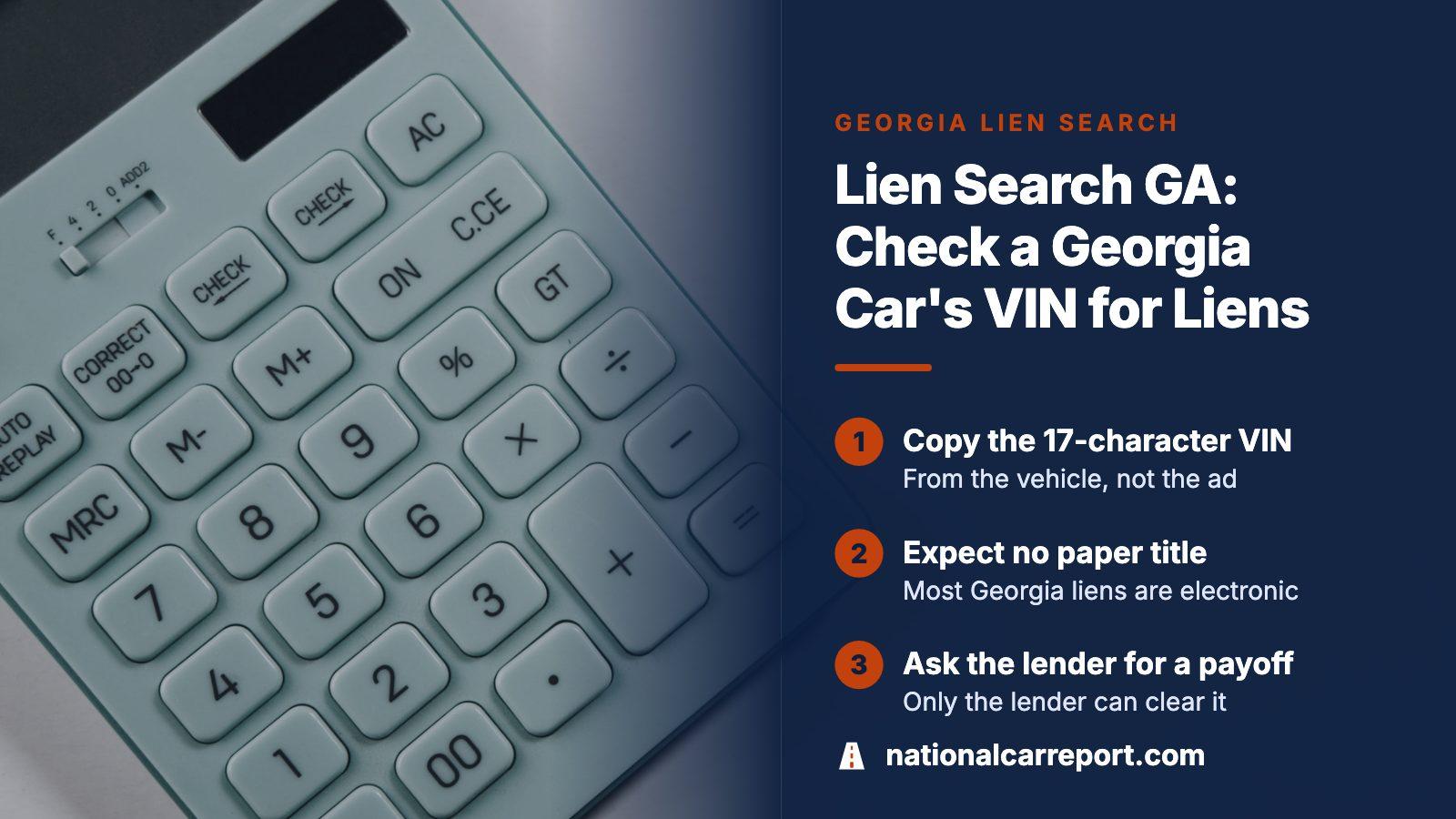
To run a lien search in Georgia, copy the 17-character VIN from the vehicle into the preview. It looks for lien, theft and impound records filed against that VIN. A listed lender means the loan may be unpaid, and only that lender can clear an electronic lien. A blank result is not proof, because national title data has no required field for lenders. Ask the seller for a written payoff.
- Search key
- The VIN, copied from the vehicle itself
- How most Georgia liens are filed
- Electronically, with no paper title printed
- Paper titles with a lender
- Generally limited to lenders with fewer than 5 Georgia-titled vehicles under lien
- Title after a payoff
- Goes to the next recorded lender or the owner within 5 days
What the VIN search reads on a Georgia car
Three outsiders can hold a claim on a car without the seller mentioning it: the lender that financed it, a tow or storage yard that once held it, and the police if it was reported stolen. Each files against the VIN, not a person. NationalCarReport's preview gathers what it can find across those records, whichever state titled the car first.
- Liens: a lender's claim, if one reached a source the search reads
- Impounds: a record that a yard held the car, and maybe sold it
- Theft: a stolen report, and whether the car came back
- Brands such as salvage or flood, which cut its value
Why a Georgia loan usually leaves no paper title to inspect
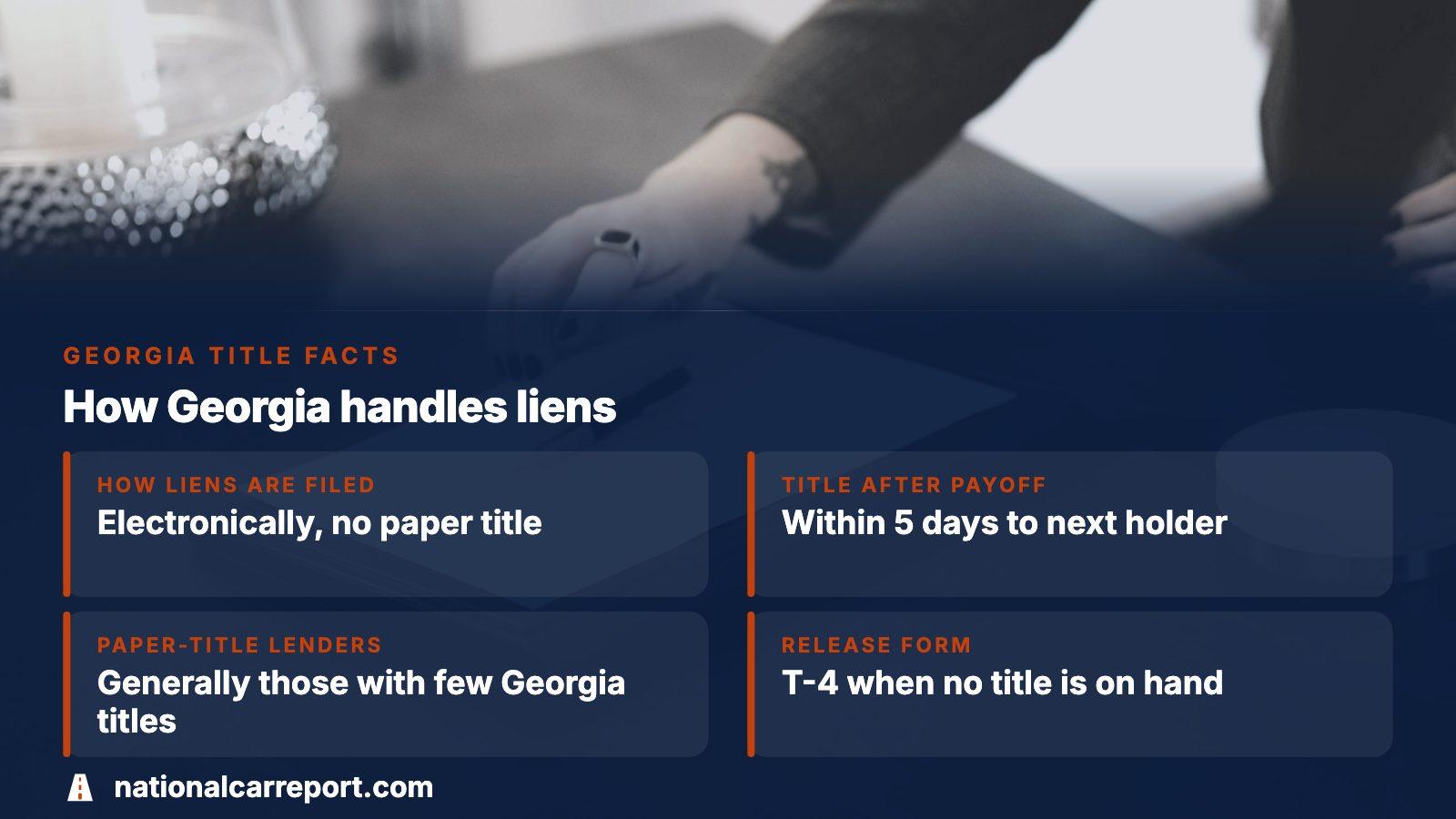
Georgia expects lenders to file and release liens through its Electronic Lien and Title program. A loan recorded that way keeps the lien and the certificate inside the state's DRIVES system, and nothing gets printed. The revenue department states plainly that it will not clear an electronic lien; the borrower has to go to the lender.
Paper is the exception. Generally only a lender with fewer than 5 Georgia-titled vehicles under lien may use a traditional paper certificate. So when a seller says the title is in a drawer but a bank has a lien, ask which lender, and whether it was filed on paper or in the system.
No paper in the seller's hand
In Georgia that alone is not a red flag, since an electronic title cannot be handed over as a document. Ask for the lender's name and a payoff letter, and keep your money back until the lender confirms the release.
From VIN to payoff letter: five steps in Georgia
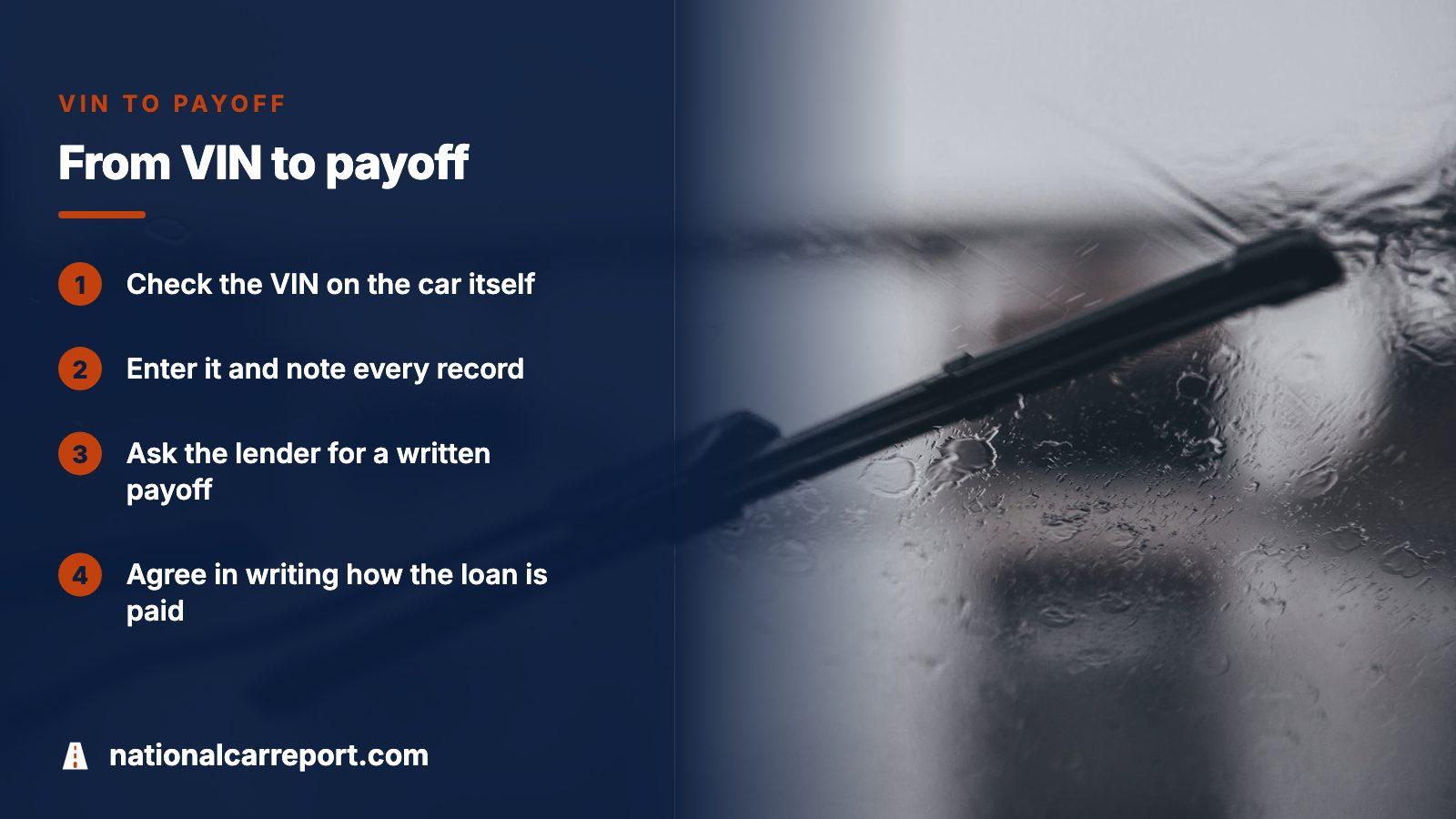
- Check the VIN on the car rather than in the ad. The dash plate by the windshield and the door-frame label should match each other and the seller's papers.
- Enter it in the preview and note every lien, theft or impound entry.
- If a lender shows up, ask the seller for its name and a written payoff figure with an expiry date.
- Find out what kind of title exists. A paper one needs the lender's signed release; an electronic one is cleared by the lender in the system.
- Agree in writing how the loan will be paid before cash changes hands.
What each result points to
| Result | What it points to | Your move |
|---|---|---|
| Lien listed | A lender filed a claim that may be open | Identify the lender, get a written payoff, pay it directly |
| No lien shown | Nothing reached the records searched | Have the lender confirm in writing |
| Theft, not recovered | The car may still be listed stolen | Walk away, and tell police if you know where it is |
| Impound entry | A yard once held the car | Ask who paid the bill and whether a sale followed |
| Title in another name | The seller may be unable to sign a release | Pause until the names match |
| Loan paid, lien shown | The release may be stuck with the lender | Request a written release from the lender |
Why a clear result still deserves a second look
National title records rest on a short list of data points, and the lender is not one. Under federal rules, states report the VIN, how the title describes the car and any brands, the owner named on it, salvage or junk-yard acquisitions where collected, and mileage, at least once every 24 hours. Coverage is partial: the system holds about 87 percent of vehicles nationwide, and over half of states contribute. A Georgia lien that stayed in state records may never reach a search.
Treat a blank as unknown
No lien on screen means none reached the records searched. Get the lender to confirm in writing before you pay.
What Georgia expects once a loan is paid
When a paper title is released, the lender fills in the release section: its name as recorded, an authorized agent's signature, and the date. The certificate then goes to the next recorded lender within 5 days of the payoff, or is mailed to the owner when no other lender is recorded. Electronic liens need no paper, since the lender clears them in the system.
- No title on hand at payoff: the lender gives the owner a signed Form T-4 release instead.
- A county tag office may verify that T-4 before accepting an application.
- A lien the lender cleared but the state record still shows needs a fresh release from that lender.
Old liens
A lien that has stood 10 years from the title's issue date needs no release, the revenue department says, except on mobile homes, cranes and vehicles heavier than 10,000 pounds. Its release page ties that to vehicles 11 model years old or older, with a 4-year window for those 12 or older. The wording overlaps, so ask a tag office which applies.
When the lender is gone, or never used the system
Sometimes the lender on the record cannot sign anything. For a closed company, the owner first rules out a merger or a rename, then obtains a regulator's letter saying it is out of business or unlicensed. For an unlicensed lender the owner also mails a registered notice to its last known address. The route excludes individuals, merged companies and unregulated lenders.
If the lender was a person who has died, an executor or heir can release the lien at a county tag office, using the title's release section or Form T-4 plus court letters or a death certificate. Heirs also file Form T-20, an affidavit of inheritance.
Claims a title search can miss
A Georgia vehicle from 1985 or older needs no title. For any vehicle without a Georgia title, the revenue department says a lien is filed under the Uniform Commercial Code with the Clerk of Superior Court of the owner's home county. Records built from titles may never show it.
Service businesses can claim a car as well. Under Georgia's Abandoned Motor Vehicle Act, O.C.G.A. 40-11-11 and following, tow operators, repair shops and salvage dealers may obtain a lien on an unclaimed vehicle through a notice process. The tower must tell the owner and any lender about an impound, and a business that forecloses must notify them again.
An impound entry deserves a phone call
Ask the seller which yard held the car, who settled the bill, and whether a public sale followed.
What it costs and where to go next
Only the preview is free, and it shows what the VIN returns before you commit. Each report is bought once for one car, and pack options exist for comparing several. Nothing renews, and the pricing page lists the rates.
If you finance the purchase, your own lender should file within 30 days of the sale so its claim counts from the contract date. Filing later brings a $10 penalty plus a Form T-53 notice. Do the transfer at a county tag office with the payoff letter in hand.
Where this information comes from
- Georgia DOR: Electronic Lien and Title program — Supports how lenders exchange lien data with the state and where lender lookups live.
- Georgia DOR: Lienholders with paper titles — Supports the electronic filing expectation, the no-paper rule and the small-lender exception.
- Georgia DOR: How to release a lien and security interest on title — Supports the release steps, the T-4 fallback and the old-lien rules.
- Georgia DOR: Recording a lien and security interest on a title — Supports the filing documents, the late penalty and liens on vehicles with no Georgia title.
- Georgia DOR: Abandoned vehicles — Supports tow, repair and salvage liens and the notice duties under the abandoned vehicle law.
- NMVTIS: information for consumers — Supports what a national title record holds and how much of the country it covers.
- 28 CFR 25.54: what states report to NMVTIS — Supports the list of items states must send, which leaves out lender data.
Sources and photos: Facts checked against the sources above in November 2026. Photos by Sasun Bughdaryan, Thibault Valjevac and Annika Wischnewsky on Unsplash; diagrams by NationalCarReport.
Keep reading
- Vehicle Lien Check by VIN: Nationwide Lien, Theft and Impound RecordsThe same check for a car from any state, not only Georgia.
- DMV Lien Release Search: How to Confirm a Lien Is GoneHow to tell whether a lender has really let go of its claim.
- Car Lien Holder Search: How to Find the Lender Behind a VINFinding out which lender holds the claim, so you know whom to ask for a payoff.
- PricingOne report or a pack, paid once, with no subscription.
Frequently asked questions
How do I run a lien search in Georgia?
Enter the car's VIN in the preview to see lien, theft and impound records. Then ask the seller who the lender is and for a written payoff. Georgia lenders mostly file electronically, so only the lender can clear the lien.
Is there a free lien search for Georgia cars?
Only the preview costs nothing; a full report means one payment and no renewal. The state lists a Title Status service among its online title tools, plus a DRIVES lookup for lenders in its electronic program, but its pages do not say what Title Status displays. Ask a county tag office.
Does a title in the seller's name prove the car is lien-free?
No. The title names the owner; a lender's claim is recorded alongside it, in the state system for electronic liens or on the certificate for paper ones. In a private sale, recorded liens against the previous owner have to be signed off in the title's release spaces, so ask to see that sign-off.
What happens to the title after a Georgia loan is paid off?
An electronic lien is cleared by the lender in the system. With a paper title, the lender fills in the title's release section, and the certificate goes to the next recorded lender, or to the owner, within 5 days of the payoff. If the title is unavailable, expect a signed Form T-4 in its place.
Can I buy a Georgia car that still has a lien?
Yes, as long as the loan gets cleared. Ask for a written payoff, pay that sum to the lender directly, and hand the seller whatever is left. Then collect the release, or proof it was filed electronically. Pay the seller first and the lender's claim stays on your car.
Now check the car itself
The guide explains what to look for. The report shows what this VIN has on record.