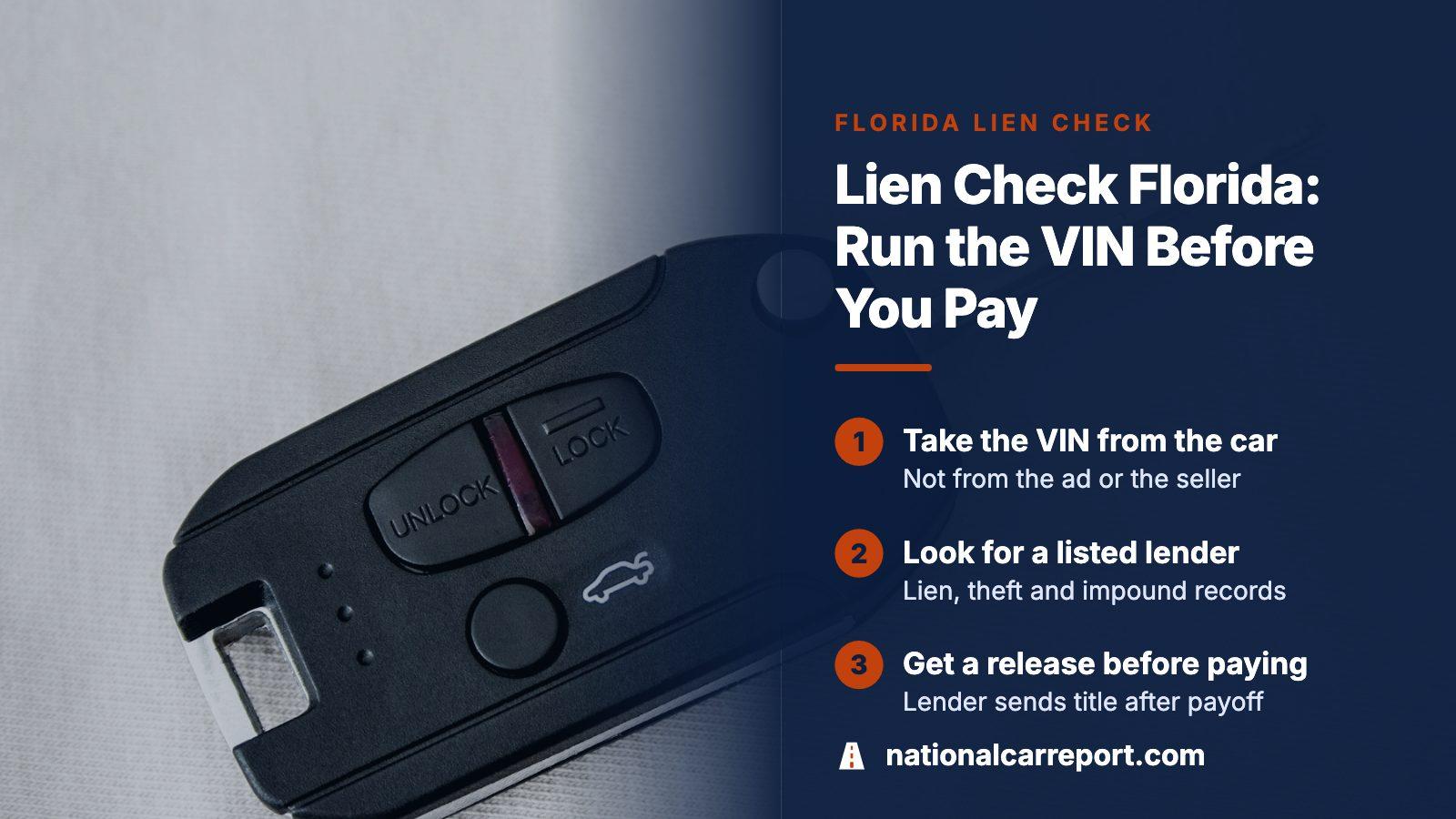
THE SHORT ANSWER
To run a lien check in Florida, take the VIN from the car and enter it in the preview. It looks for lien, theft and impound records tied to that VIN. When a Florida record lists a lien, some lender could still be owed money, and that debt has to be settled and the lien released before the title is clean. A clear result is a screen, not proof, because national title records do not require lien data. Confirm the lender's status against the Florida title itself.
- Search key
- The VIN, read off the car
- Where a Florida lien is noted
- The certificate of title, on paper or in the state's electronic record
- Lender's clock after payoff
- 10 working days to send the release and title
- Old lien removal
- An owner may apply once a lien has stood for 5 years
Three kinds of claim a Florida VIN search looks for
A car can be claimed from three directions at once. A lender may have financed it, police may have taken a theft report, and a tow operator may have held it over unpaid fees. All three attach to the VIN, so NationalCarReport's search gathers what was filed, even if the car was titled elsewhere first.
- Lien: a lender's claim on the car, if one reached a source the search reads
- Theft: a stolen-vehicle report, and whether the car ever came back
- Impound: a record that a tow or storage yard held the car
- Salvage or rebuilt brands on the title, which cut what the car is worth
Where a Florida lien is recorded
In Florida a car loan becomes a lien when it is noted on the certificate of title. Florida Statutes section 319.27 says an unnoted lender claim cannot be enforced against creditors or good-faith buyers, so the notation is what gives the lien its force.
The state also runs an electronic titling program. Lenders that finance cars for a living must send liens and releases to it electronically, and a database entry can stand in for the paper certificate. A seller with no paper may be honest. What matters is whose name the record carries and whether a lender is listed.
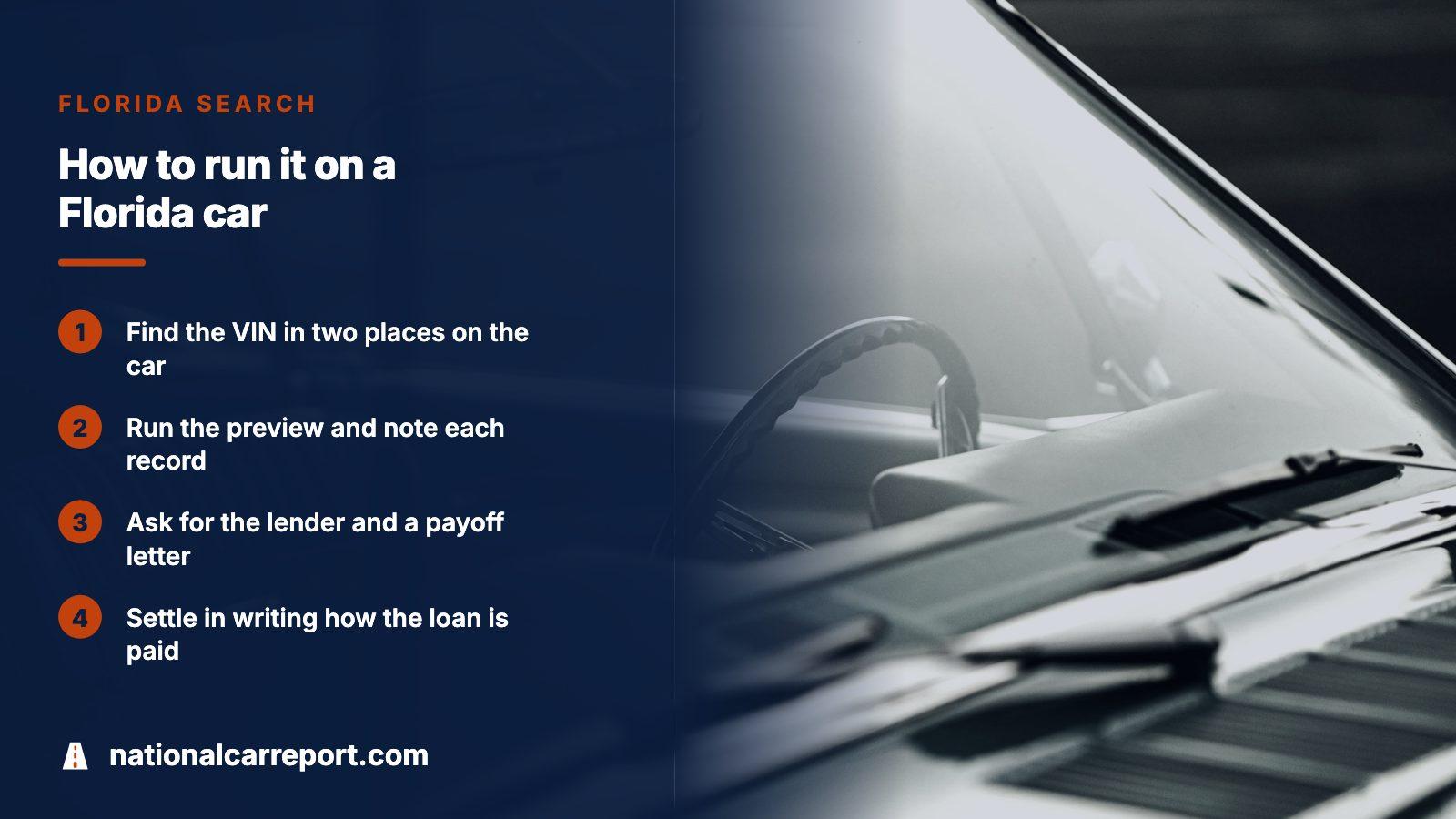
How to run it on a Florida car
- Find the VIN at two spots on the Florida vehicle and compare each against the paperwork. The first can be read from outside, down at the base corner of the windshield; the second is printed on a label in the driver's doorway.
- Enter it in the preview and write down any lien, theft or impound record.
- If a loan comes up, request the lender's name from the seller, plus a payoff letter that states the amount and its expiry date.
- Have the seller produce the title, paper or electronic, under their own name, and check its VIN against the car.
- Settle in writing how any loan gets paid before you hand over money.
What each result suggests and what to do about it
| Result | What it suggests | Your move |
|---|---|---|
| Lien listed | A lender reported a claim that may still be open | Identify the lender, get a payoff in writing, pay the lender directly |
| No lien shown | Nothing reached the sources the search reads, which proves little | Ask for the title in the seller's name and have any lender confirm in writing |
| Theft record, not recovered | The car may still be listed as stolen | Do not buy, and tell police if you know where it is |
| Impound record | A tow or storage yard once held the car | Ask who settled the bill and whether a sale or bond followed |
| Title in someone else's name | The seller may be unable to sign a release | Stop until the names line up |
| Loan repaid, lien still showing | The release may be stuck with the lender | Ask for the lender's written release and check the deadlines below |
Why a clear result still needs a second look
The national title system collects five things from each state: the VIN, what the title says about the car including brands, who it was issued to, junk or salvage acquisitions where the state records them, and odometer readings. Updates are due every 24 hours. A lender's name is not on that list. A state may add more by agreement, but nothing requires it. The federal consumer page also warns that coverage is partial, with roughly 87 percent of vehicles in the system and over half of states contributing.
Treat a blank as unknown
No lien on the screen means none reached the sources it reads. Get the title in the seller's name, and let the lender confirm in writing before money moves.
How fast Florida expects a lender to release a paid-off lien
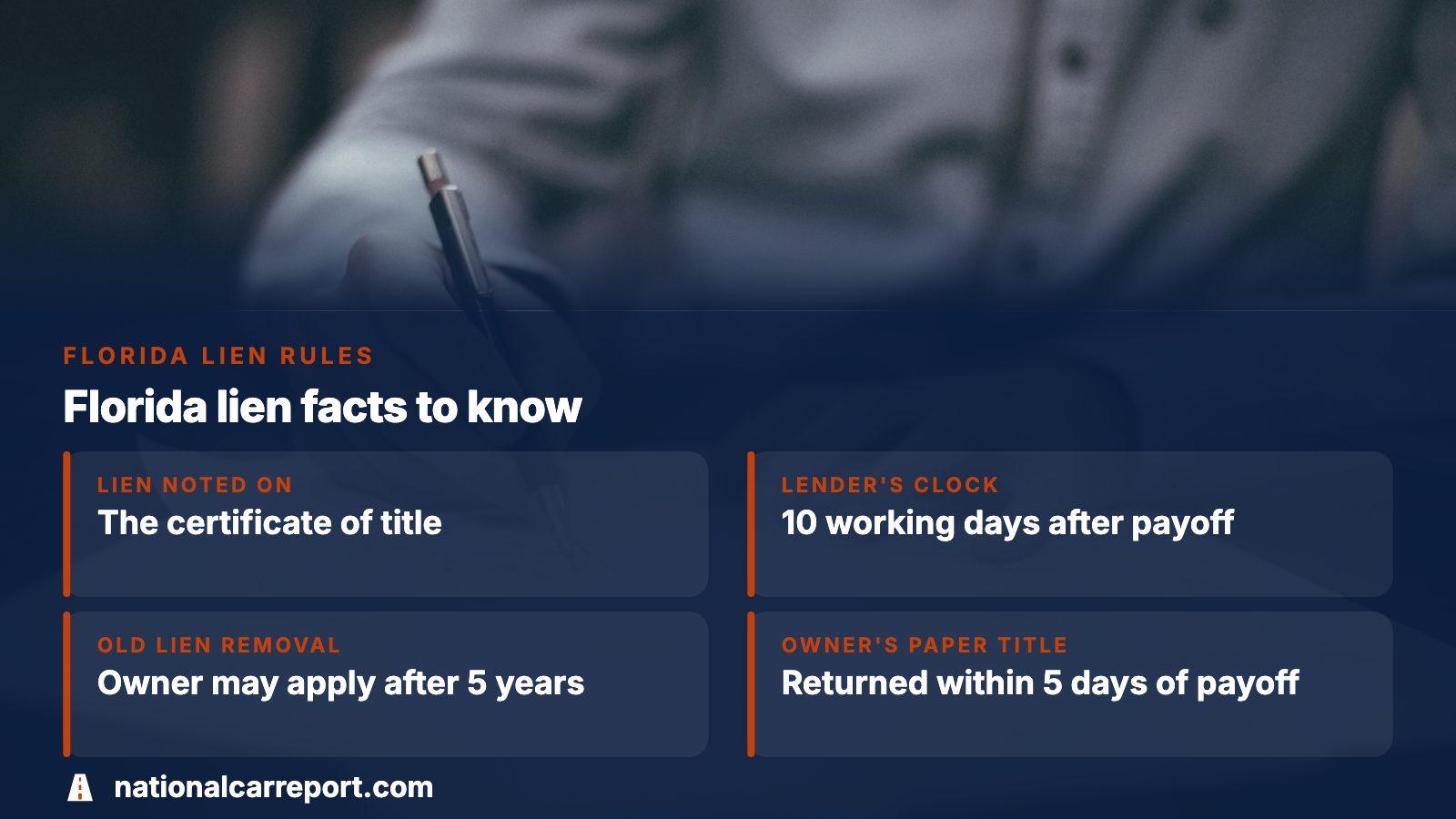
Florida Statutes section 319.24 starts a clock when a loan is repaid.
- The lender has 10 working days from the final payment to send the release and the title, or to say the title is unavailable.
- An owner who kept the paper title has 5 days after the payoff to return it. The lender has 10 days to forward the release to the state.
- A dealer taking in a trade with a purchase-money lien has 10 working days to pay it off.
- A lender that stays silent for 30 days after demand can face a suit to cancel the lien, with costs and fees on top.
- Ignoring the state's certified-mail demand for 10 days is a second-degree misdemeanor.
Paid off is not the same as released
The statute presumes a title still carries a lien until a new one reaches the person who paid it off. A seller who says the loan is gone should show the release or a title with no lender on it.
A lien that outlived its loan
Occasionally a lien stays on the record long after the debt is gone. Florida lets an owner apply in writing to remove one that has been on file for 5 years. The owner must show the lender was warned by certified mail at least 20 days earlier, and the state may act 10 days after the application arrives if the lender has filed no written protest.
If the lender answers that money is still owed, the lien stays until a satisfaction is produced. As a buyer, make this the seller's job, finished before you pay.
Tow and storage liens, which come from no loan
A towing and storage operator can claim its own lien under Florida Statutes section 713.78. It must send certified-mail notice to the registered owner, the insurer and every lienholder within 5 business days after storage begins. An unpaid car can go to a public cash sale, no sooner than 35 days after storage if the car is more than 3 model years old, or 57 days if it is newer. A sale clears the title of liens unless a court orders otherwise.
Operators search too
The statute counts searches of the state motor vehicle agency and the national title system toward an operator's good-faith effort. If your search shows an impound, ask who paid the yard and whether a sale followed.
What it costs and where to go next
Only the preview is free, and it lays out what the VIN returns before you commit. Should you continue, the full report is paid once per car, with multi-car packs available for shoppers weighing several; no charge ever repeats. Current pricing is laid out on the pricing page, and the sample report shows how results are laid out. Then handle the transfer through a county tax collector's office with the lender's payoff letter in hand, and treat any pressure to hurry as a warning.
Where this information comes from
- Florida Statutes 319.27: notice of lien on motor vehicles — Source for how a lien is noted on the title, which claims can be enforced, and the electronic lien program.
- Florida Statutes 319.24: duplicate certificates and lien satisfaction — Source for the payoff clock, the owner's return of a paper title and the lender's penalties.
- Florida Statutes 319.241: removal of lien from records — Source for how an owner can ask the state to drop a lien that has stood for 5 years.
- Florida Statutes 319.28: title after repossession — Source for the notice and protest windows around a repossession.
- Florida Statutes 713.78: towing and storage liens — Source for tow-yard notice, sale timing and what a sale does to liens.
- NMVTIS: information for consumers — Source for what a national title report holds and where its coverage ends.
- 28 CFR 25.54: what states report to NMVTIS — Source for the list of items states must send, which leaves out lienholders.
Sources and photos: Facts checked against the sources above in November 2026. Photos by Shadow Photography, Dylan Michaud and Scott Graham on Unsplash; diagrams by NationalCarReport.
Keep reading
- Vehicle Lien Check by VIN: Nationwide Lien, Theft and Impound RecordsThe same check for a car from any state, not only Florida.
- DMV Lien Release Search: How to Confirm a Lien Is GoneHow to tell whether a lender has really let go of its claim.
- Car Lien Holder Search: How to Find the Lender Behind a VINWorking out which lender holds the claim, so you know whom to ask for a payoff.
- PricingOne report or a pack, paid once, with no subscription.
Frequently asked questions
How do I do a lien check in Florida?
Run the car's VIN through the preview to see lien, theft and impound records. Then have the seller show you the title made out to them personally, and ask who the lender was if a loan existed. A Florida lien is noted on the title record, so the lender's written confirmation settles what a database cannot.
Is there a free lien check for Florida cars?
The preview alone is free, while the full report is paid for once. A national title report may show no lien at all, because lender details are not among the items states must send. Rely on the title itself and the lender for a firm answer.
Can I buy a Florida car that still has a lien?
Yes, as long as the payoff reaches the lender. Get a written quote, send that amount to the lender and pay the seller only the difference. Then collect the release, or proof it was filed electronically. Paying the seller first leaves the lender's claim attached to a car that is now yours.
How long does a Florida lender have to release a lien?
Section 319.24 gives the lender 10 working days from final payment to send the release and title, or to say the title is unavailable. If no release arrives within 30 days after you demand one, the lender can be sued to cancel the lien and may owe costs and legal fees.
What if the car was repossessed or came from another state?
A lender repossessing a car must mail certified notice to any later lienholder at least 5 days before selling it, and if nobody protests within 15 days of mailing, the title issues showing no liens. For a car from elsewhere, Florida notes the earlier state's liens on its first title, so ask where it was titled before.
Now check the car itself
The guide explains what to look for. The report shows what this VIN has on record.