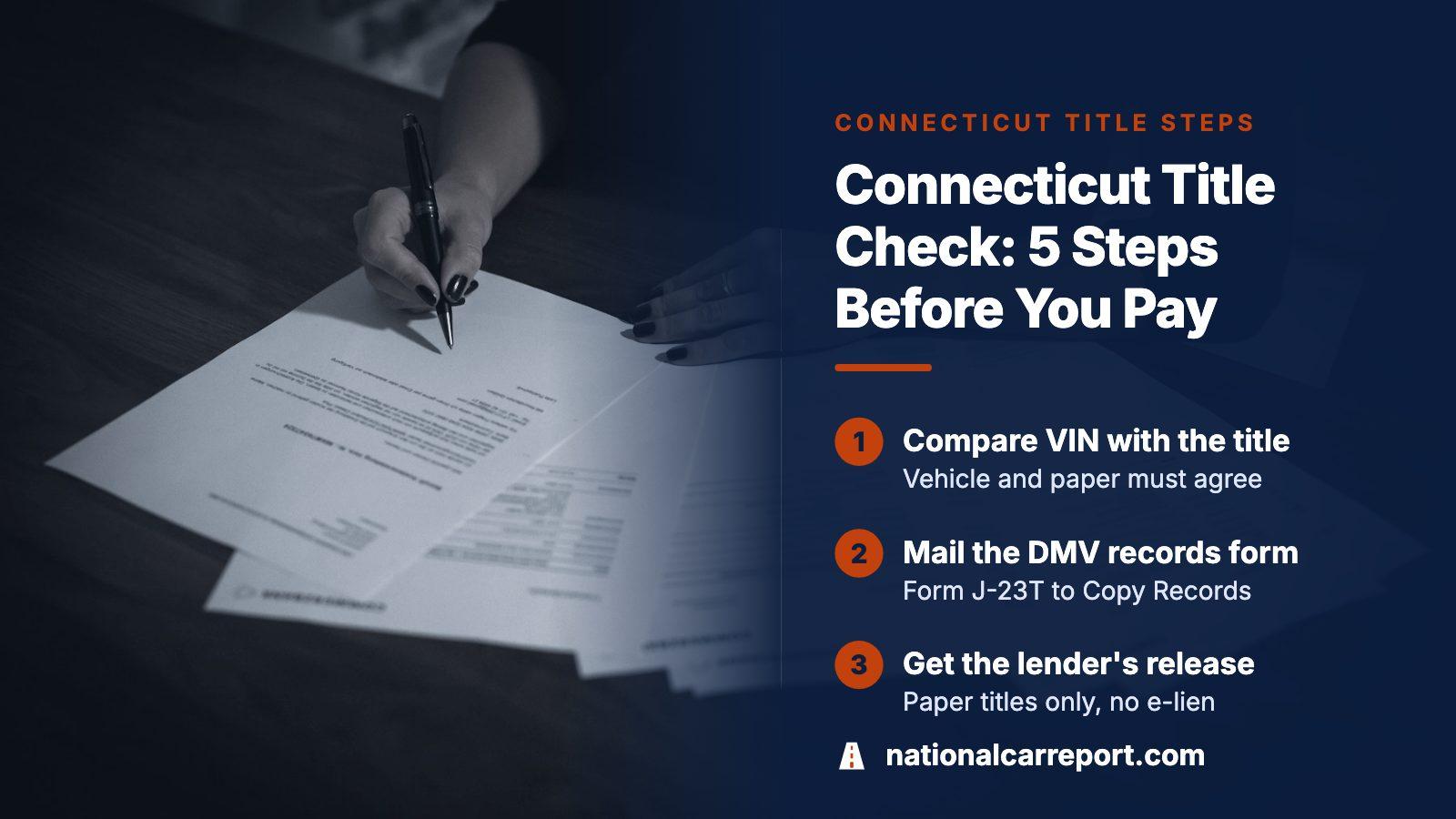
THE SHORT ANSWER
A Connecticut title check runs in five steps: confirm the VIN on the vehicle matches the title, screen the VIN for theft, lien, impound and brand records, mail form J-23T to the DMV Copy Records Unit, get any lender's release in writing, and rule out a tow claim. A blank screen means only that nothing was reported.
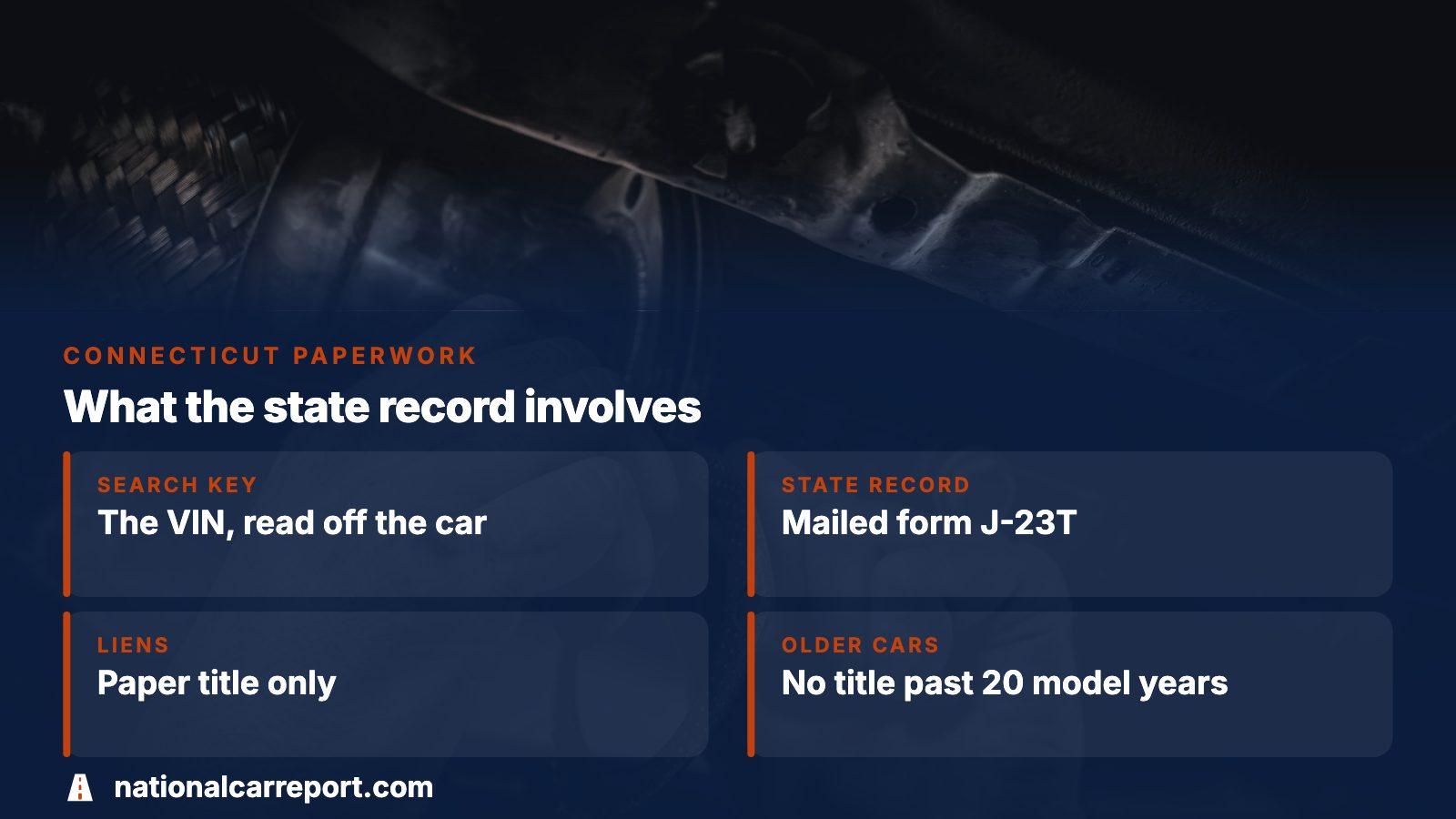
- Search key
- The VIN, read off the car
- State record
- Mailed form J-23T, $20 per record
- Liens
- Paper title only, no electronic program
- Older cars
- No title needed past 20 model years
What a Connecticut title search can and cannot tell you
NationalCarReport reads a used car through the claims other people can make on it: a lender, an owner whose car was stolen, a tow yard with a bill. Connecticut keeps those in different places, so no single lookup answers everything.
- Owner: the name on the title and the DMV record
- Lender: whether a lien exists and who holds the title
- Theft and impound: reports filed against the VIN anywhere in the country
- Brands: salvage, rebuilt or flood labels applied by any state
Step 1: Compare the car's VIN with the title
Hold the paperwork up against the car itself. Check every character of the VIN on the vehicle against both the title and the bill of sale; one wrong digit is the cheapest warning a buyer ever gets.
A registering buyer needs form H-31 (a bill of sale) or form Q-1 (a supplemental assignment of ownership), so get one signed at the handover. Once a vehicle is more than 20 model years old, Connecticut no longer requires a title. An older car without one can be legitimate, but then the seller owes you the last registration plus a Q-1 or H-31.
When the names differ
A seller whose name is absent from the title has to explain the gap and show the paper that closes it. Until then, keep your cash.
Step 2: Screen the VIN for theft, lien and impound records
Put the VIN into the free preview before making the trip. It reports what record types turn up under that VIN: theft, liens, impound entries and title brands. The full detail sits in a one-off paid report, and the pricing page shows the options.
Connecticut's attorney general also advises a VIN history check and names two tools: federal NMVTIS reports, priced up to $4, and a free NICB database that takes a VIN. NMVTIS is built around five items: current title state, brands from any state, odometer, total loss history and salvage history. Liens and theft are absent from it, so a spotless federal record proves little on either.
A blank result is a screen, not a clearance
A VIN search returns only what someone filed. A lien or theft that never reached a national record stays invisible, which is why steps 3 to 5 exist.
Step 3: Ask the DMV for its own title record by mail
Connecticut's own title search is a mailed request. Send form J-23T to the Copy Records Unit in Wethersfield with the VIN, make, year and a copy of your photo ID. A Title Record request brings back a computer record of title, owner and lien details, though the form stresses that it is no substitute for a duplicate title.
Each record costs $20, and certifying a copy adds $20. Pick current information or the current record plus the previous 4 years. A title history as of a date you name is also on the form, and Section 3 adds odometer readings and ownership history.
Whose record is it?
Anyone asking for another person's record must state a permitted purpose, and the form has a separate choice for your own. A seller who wants to prove a clean title can order their own copy. Mail takes time, so plan this step ahead of the sale.
Step 4: Settle any lien with the lender before you pay
Connecticut runs no electronic lien program and cannot receive electronic lienholder records, so a lender's claim lives on paper. With a lien, the DMV mails the title to the lienholder, and the owner may be carrying only a six-month courtesy registration.
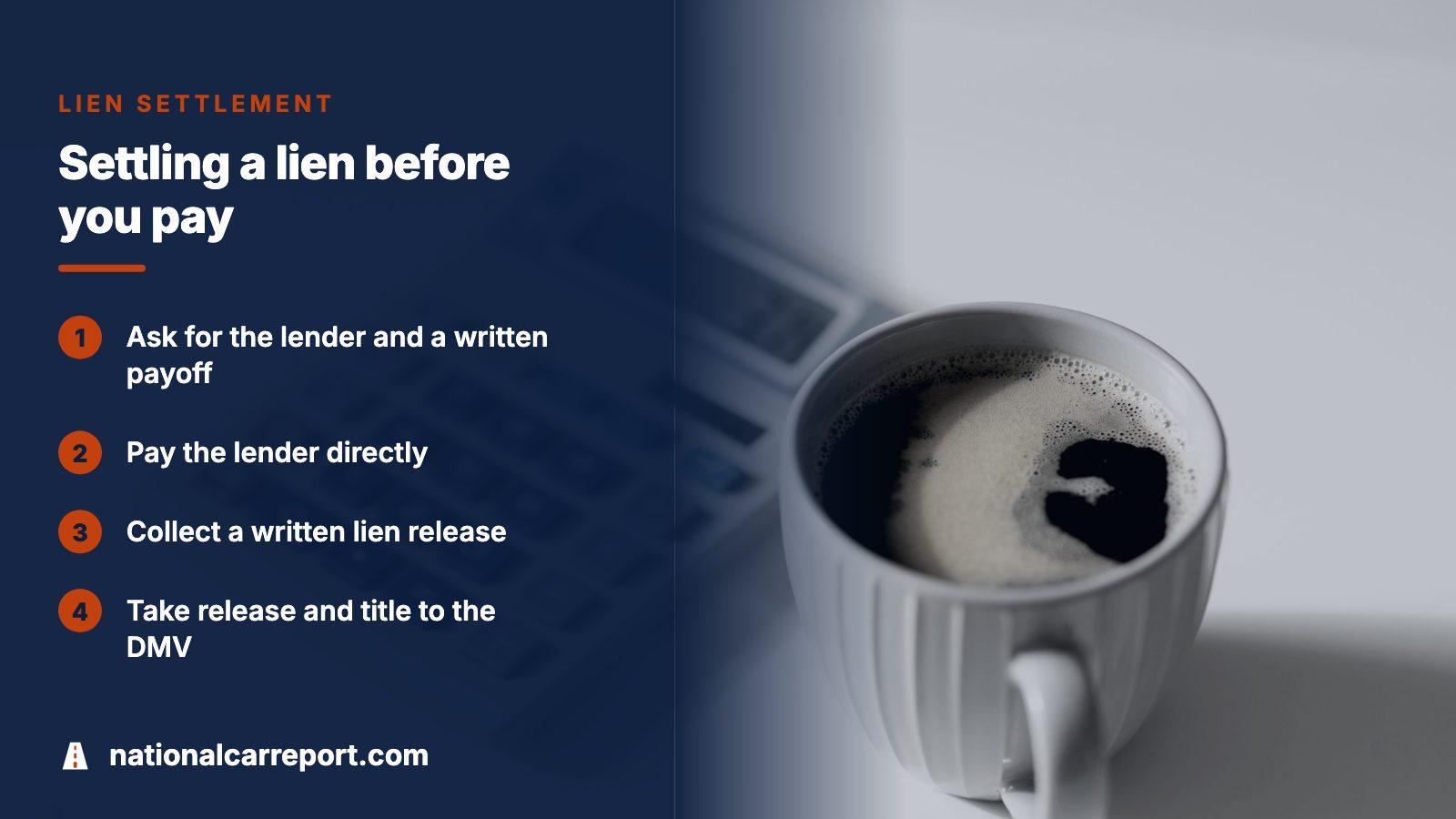
- Ask who the lender is and request the payoff amount in writing.
- Pay the lender directly; the seller receives only what is left.
- Collect a release on the lender's letterhead that names the owner and the car, states the loan is paid or the lender claims nothing, and carries an authorized agent's signature.
- Or take the title stamped paid by the lender, which Connecticut lets an owner keep for a later sale.
- Take the release and the signed title to the DMV when you apply in your own name.
For a loan over a decade old with no release available, the DMV offers Section 2 of form H-6B or the ownership affidavit H-115.
Step 5: Rule out a tow or storage claim
Impound is the record buyers forget. A Connecticut police tow left unclaimed for 48 hours leads to form H-114 in the mail for the owner and any lienholder. A tower who removes a car from private property calls local police within 2 hours and sends H-114 by certified mail after the same 48 hours.
Unclaimed cars get sold. A car worth $1,500 or less can be filed for sale after 15 days, while a costlier one is held 45 days in all, with a letter to owner and lienholder at least five days before the auction. The DMV's towing lookup is limited to licensed dealers and repairers, so you cannot run it. Treat an impound entry, or a seller vague about where the car spent a month, as a cue to ask for the tow receipt.
How Connecticut words a brand, and what each one allows
| On the title | What it means in Connecticut |
|---|---|
| Salvage | An insurer judged the car a total loss; driving it anywhere in the state is illegal and its registration is cancelled. |
| Rebuilt | The car passed a DMV salvage inspection and was retitled with the word Rebuilt printed on it. |
| Salvage Parts Only, Unrebuildable or Unrepairable | The car can never be registered or retitled, whatever repairs follow. |
The $88 salvage inspection needs part receipts, the insurer's appraisal and a photographed repair report, so a seller claiming a rebuild should hold that file. A salvage owner must obtain a duplicate title bearing the Salvage legend before selling. Brands from other states travel with the VIN through NMVTIS, and Connecticut holds a title back when those results raise questions until the DMV researches further.
What each finding means and your next move
| Finding | What it suggests | Your move |
|---|---|---|
| Lien listed | A lender may still hold a claim | Get a written payoff figure and a release before paying |
| No lien shown | Nothing was reported, and Connecticut has no electronic lien program | Ask for the paper title and the DMV record |
| Theft record, not recovered | The car may still count as stolen | Do not pay; tell the police if you know where it is |
| Impound record | A tow yard held the car | Ask for the tow receipt and who settled the bill |
| Salvage brand | An insurer wrote the car off | Demand the inspection file before trusting a rebuilt label |
| Seller not on the title | The seller may be unable to sign | Walk away until the names line up |
Cost, and what to do once the paper holds up
The free preview shows record types; the full report is paid once, and the sample report shows how findings are laid out. Connecticut's DMV does not regulate private sales, so a dispute afterward becomes a civil case in small claims or Superior Court. Add a mechanic's inspection, because records say nothing about the transmission. Then register: titles issue about 30 days after registration, mailed to the lender if there is a lien, and an owner whose title never arrives has 90 days to reapply at no cost.
Where this information comes from
- Connecticut DMV: Make changes to a car title — Source for the mailed title search, lien release letter, paid title and the 30 and 90 day timing.
- Connecticut DMV: Copy records title request, form J-23T — Shows what a title record returns, the record options, fees and the permitted-purpose rule.
- Connecticut DMV: Proof of ownership requirements — Covers the 20 model year title exemption, bill of sale forms and the lack of electronic lien records.
- Connecticut DMV: Salvaged and totaled vehicles — Explains the salvage, rebuilt and parts-only wording and the inspection file.
- Connecticut DMV: Towing procedures and rates — Gives the tow notice forms, holding periods and the limits of the DMV's towing lookup.
- Connecticut Attorney General: Buying a used car — Source for the VIN history advice, private sale remedies and the mechanic inspection tip.
- NMVTIS: Understanding a vehicle history report — Lists the five items a federal title history report is meant to cover.
Sources and photos: Facts checked against the sources above in November 2026. Photos by Dimitri Karastelev, Ben Wicks and Martin Fennema on Unsplash; diagrams by NationalCarReport.
Keep reading
- Vehicle Lien Check by VIN: Nationwide Lien, Theft and Impound RecordsThe nationwide version of the lien step, for a car from any state.
- Stolen Car Check by VIN: Nationwide Theft, Lien and Impound RecordsHow a theft report shows up on a VIN and what to do with a hit.
- Impound Lookup: Find a Towed Car, Then Check Its VIN for Impound RecordsTracing a car that was towed or held in a storage yard.
- PricingOne report or a pack, paid once, with no subscription.
Frequently asked questions
How do I do a Connecticut title check?
Read the VIN off the car and confirm it matches the title, screen it for theft, lien, impound and brand records, then mail form J-23T to the DMV for its record. Get any lender's release in writing. The DMV search costs $20 and travels by mail.
Is there an online Connecticut title search?
The DMV's title search runs on mailed form J-23T. Online options run on the VIN: NMVTIS reports cost up to $4 and show title state and brands, while a VIN preview screens for theft, lien and impound records. Neither is the DMV's own record.
Does a Connecticut title show liens?
Liens are tracked on paper. With a lien, the DMV mails the title to the lender, and once the loan is paid the lender stamps it. Connecticut has no electronic lien program, so the title and a release letter are your proof.
Do I need a title for an old car in Connecticut?
Not if it is more than 20 model years old. The DMV page words that cutoff in two slightly different ways, so confirm a car near the line with the DMV. With no title, ask for the last registration plus form Q-1 or H-31, and screen the VIN.
What if the Connecticut title says Salvage?
A salvage car cannot be driven in the state until it passes a salvage inspection and is retitled as Rebuilt. One branded Parts Only, Unrebuildable or Unrepairable can never be registered or retitled.
Now check the car itself
The guide explains what to look for. The report shows what this VIN has on record.