THE SHORT ANSWER
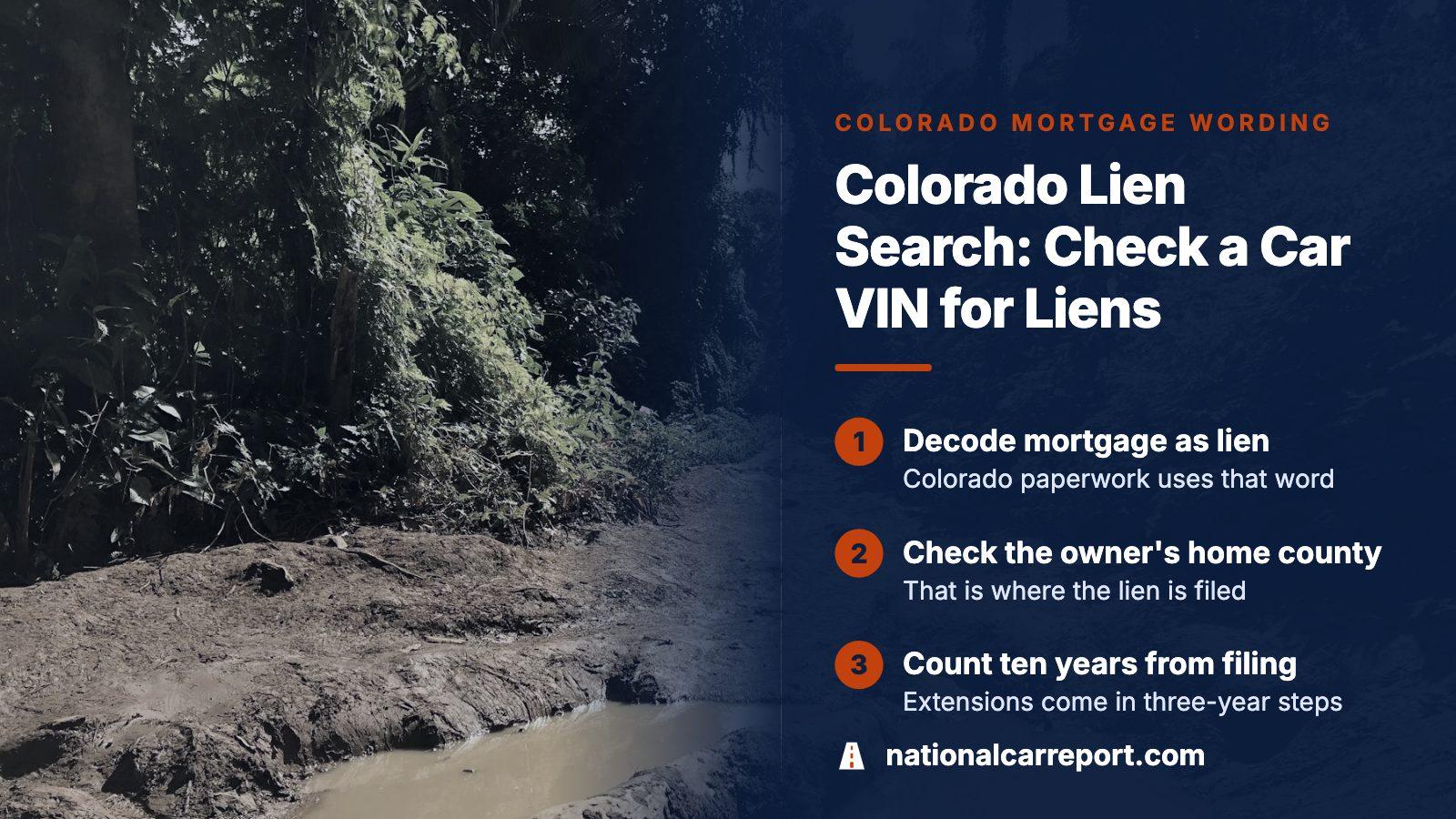
To run a Colorado car lien check, enter the VIN into the preview and look for a lender, an impound or a theft flag. A named lender means a loan may still be open. Colorado calls a lien a mortgage, files it in the owner's home county and lets it stand for ten years, so ask the seller for a signed release.
- Search key
- The VIN, taken from the car itself
- Lien life
- Ten years from filing, extendable in three-year steps
- Liens on one title
- Up to four can be shown
- Filed in
- The county where the owner lives
What a Colorado lien search is looking for
Debt is only one claim a car can carry. The bank that financed it, a yard that once towed it and the police, if it was reported stolen, each leave a record tied to the VIN. The preview reads all three, whichever state first titled the car.
- Lender claims: a named bank, credit union or finance company, where one reached a source the search reads
- Impound records: proof a yard held the car, and whether it was sold to cover charges
- Theft records: a stolen report and what happened to the car afterward
The preview costs nothing. A complete report is a different, single payment for cars still on your shortlist.
Why Colorado paperwork says mortgage, not lien
Search a Colorado form for the word lien and you may come up short. The state's title manual talks about mortgages and chattel mortgages, meaning a security agreement that pledges the vehicle for a loan. That agreement creates the claim and doubles as public notice.
The agreement names borrower and lender with addresses, the make, model year and VIN, and the loan's date and amount. Counties store these apart from land records, indexed by VIN, owner, title number, plate or lender, so every claim has a findable home.
What this means for you
A seller who says nothing is owed may be describing a loan the county has on file. The VIN is the cleaner way in, since it ties every claim to the car and not to the person selling it.
Running the search at the car
Start at the vehicle: find the VIN on the dash, then check that title and registration carry the same digits. Any difference means stop before searching. Typing one wrong character pulls up a different car, or none.
- Note the VIN on the windshield-side dash plate and the driver's door label.
- Key it into the preview; the lien, impound and theft lines come back.
- Request the title from the seller, or the lender's name if a bank holds it.
- Order the full report whenever something looks unsettled.
Plate and owner-name searches are not part of this check. Holding just a plate, ask the seller for the VIN or look on the registration paper.
Reading a hit, and reading a blank
A named lender usually means the car backs a loan not yet marked paid. The seller may be current on it; the catch is that the lender, not the seller, holds the last word on the title until it signs off.
| What the search shows | What to do |
|---|---|
| A lender is named | Ask for a payoff figure and a written release before paying |
| An impound record | Find out why the car was held and who settled the charges |
| A theft record | Do not buy until the record is explained in writing |
| Nothing at all | Still ask to see the title, because no record is not proof |
A blank narrows the risk without ending it. Claims reach data sources at different speeds, and a brand-new loan may not show yet.
How long a Colorado lien lasts
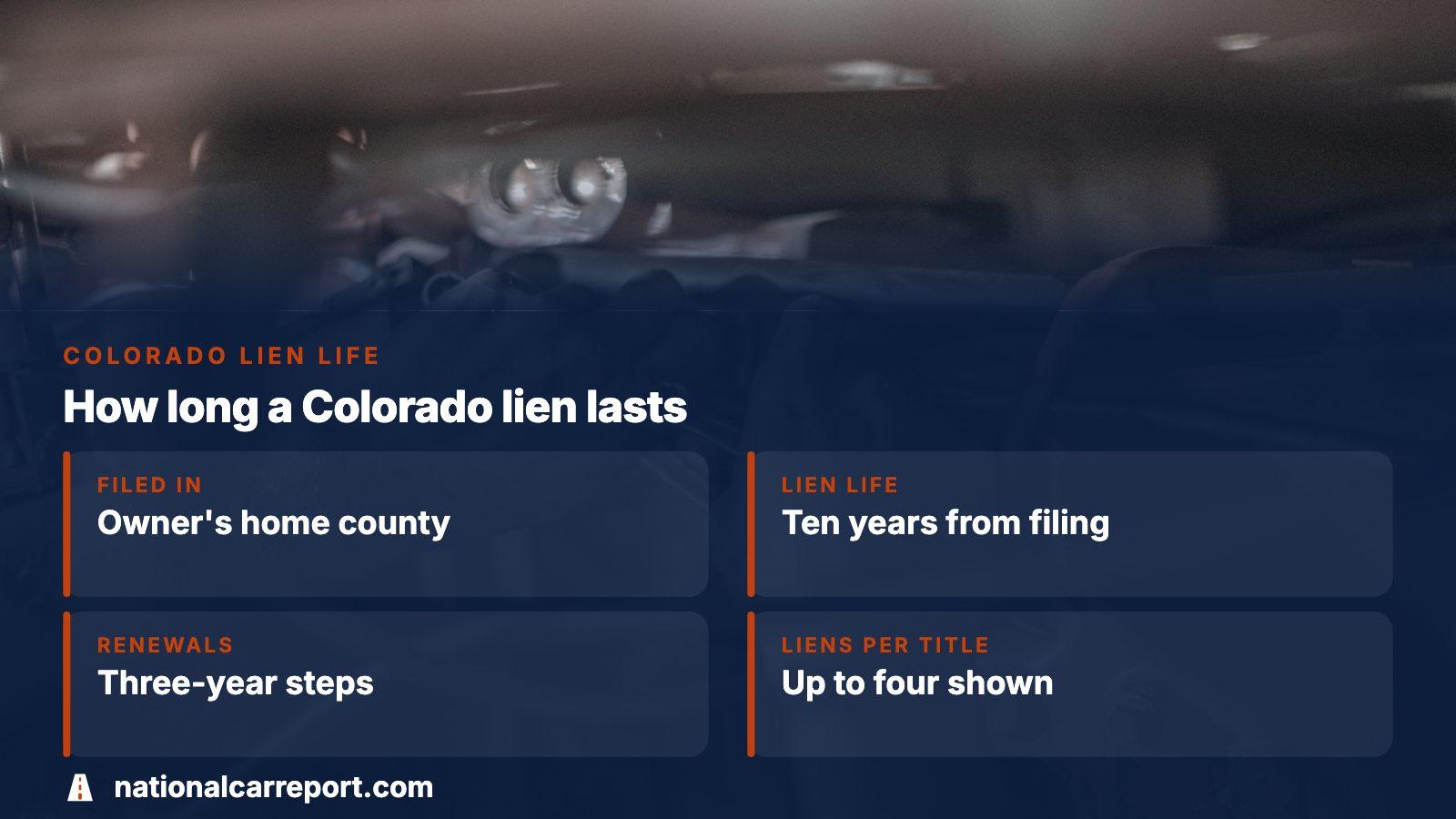
On an ordinary vehicle a claim holds for ten years after filing. The lender can renew it in three-year steps with form DR 2393, which states the original amount and the balance still owed. If the renewal is missed, a fresh filing is needed.
Since July 1, 2025, the filing date is the day the county motor vehicle office got the paperwork, printed on the title as Received Date. One title can list up to four lenders in order, which matters on a refinanced car.
- Filed in the owner's home county
- Ten years, then three-year renewals
- Motor homes and trailers follow the loan's maturity date
Electronic titles and why the seller may have no paper
Colorado runs an electronic lien and title program. When a participating lender holds the loan, the state keeps the title as a data record and prints nothing; the application carries the lender's electronic number instead of a name and address.
Payoff flips that. The lender sends the release electronically, and the state then mails a paper title to the owner. A seller with no title on a financed car may be waiting on that mailing, or may still owe the loan. A lender's payoff letter plus proof of release answers which.
At the handover
On a financed car, pay the lender directly if you can, or meet at its branch, so release and payment happen together.
What a valid release looks like, and cars from other states
For a Colorado-filed claim, the lender signs off on the title or a separate sheet. Its name has to match the one printed on the title, with an agent's signature and a date. A separate sheet adds the car's year, make and VIN, the owners' names and a sworn or notarized statement.
Cars from other states are handled differently. A claim never recorded in Colorado is marked on the new title as not filed in Colorado, and the title goes directly to the owner. A signature on the face of that title does not clear it; the lender must supply its own separate release.
An old Colorado title whose lender is past its maturity date may be accepted without a release. As a buyer, ask for one anyway.
Asking the state for its record
Colorado's motor vehicle division can search by VIN, by title number or by plate, with a single plate allowed per request. If a record exists, the result describes the vehicle and any lien, and may add the owner's name and mailing address where appropriate.
A request goes on form DR 2489A, which you mail to the state's title section in Denver or hand in at the revenue department's Lakewood office. These records are confidential. Someone seeking another person's record must declare a use or bring that person's signature, under the federal Driver's Privacy Protection Act.
Lenders recovering on a debt are among the permitted users. An ordinary buyer is better served by the VIN preview and the seller's papers. Confirm the current fee with the DMV first.
Claims that are not car loans
A garage or storage lot can also claim a car. Colorado lets a repair or storage holder act once charges sit unpaid for 30 days, and treats a car as abandoned after 30 days without owner contact. Notice must go to the owner by mail at least 15 days before a sale.
These claims seldom appear on a title. They turn up in impound and yard records, which is why the preview reads those. A car sold out of a yard should come with paperwork on how the seller came to own it.
Cost, and the steps after the preview
The preview is free. For the whole record there is one payment, no subscription and no renewal; see the pricing page for the single report and the multi-report packs.
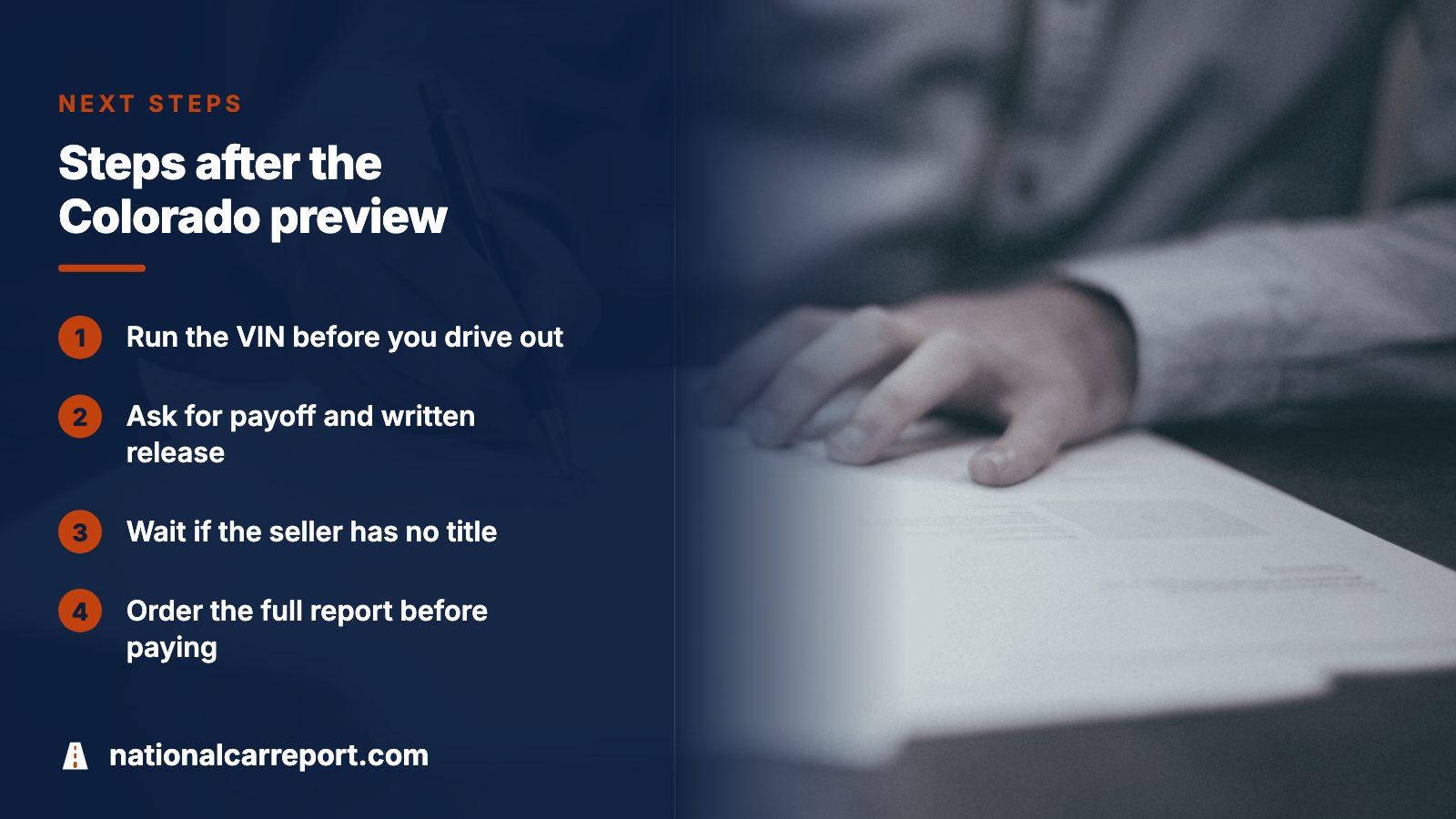
- Run the preview on the VIN before you drive out.
- If a lender appears, ask for the payoff and a written release.
- If the preview is clean but the seller has no title, wait.
- Order the whole report for any car you intend to pay for.
The combination to look for: a clean preview, and a title in the seller's own name, in hand.
Where this information comes from
- Colorado DMV Title and Registration Manual: Mortgages — how Colorado files, extends and releases a lender's claim
- Colorado DMV Title and Registration Manual: Record Searches — how to ask the state for a vehicle record
- Colorado DMV Title and Registration Manual: Electronic Lien Title — why titles on financed cars may exist only in electronic form
- Colorado DMV Title and Registration Manual: Storage Lien — repair and storage claims, notice and timing
- Department of Justice: NMVTIS for consumers — what the national title system covers for buyers
Sources and photos: Facts checked against the sources above in November 2026. Photos by Frederick Rosa, Scott Graham and Nina Mercado on Unsplash; diagrams by NationalCarReport.
Keep reading
- Vehicle Lien Check by VIN: Nationwide Lien, Theft and Impound RecordsThe same check for a car titled in any state.
- DMV Lien Release Search: How to Confirm a Lien Is GoneConfirm the lender really let go of its claim.
- Car Lien Holder Search: How to Find the Lender Behind a VINWork out who holds the loan on a car.
- Denver impound lookupSee how to trace a car held by a Denver tow yard.
Frequently asked questions
How do I do a Colorado lien search on a car?
Copy the VIN from the car into the preview and read the lender, impound and theft lines. If a lender shows, ask the seller for the title and a payoff letter. The state's own record search is a separate paper request on form DR 2489A.
Can I search for a Colorado car lien by license plate?
The preview searches by VIN, not plate. The state's record request does accept a plate, one per request, but it is limited by privacy law to permitted uses. The easier route is to get the VIN from the seller, the registration or the insurance card.
How long does a lien stay on a Colorado title?
On an ordinary vehicle, ten years from filing, with the lender able to extend in three-year periods. Motor homes and trailers follow the loan's maturity date. A lender that lets the period lapse has to file again.
What is a lien not filed in Colorado?
It is a lender's claim recorded in another state that Colorado noted on a new title when the car arrived. The title goes to the owner, and clearing it needs a separate signed release from that lender, since a release on the Colorado title face does not count.
Does a clean preview mean the car has no loan?
No. It means the sources the search reads showed no claim. A very recent loan may not have reached them yet. Ask for the title in the seller's name and, if a lender ever held the car, a signed release.
Now check the car itself
The guide explains what to look for. The report shows what this VIN has on record.