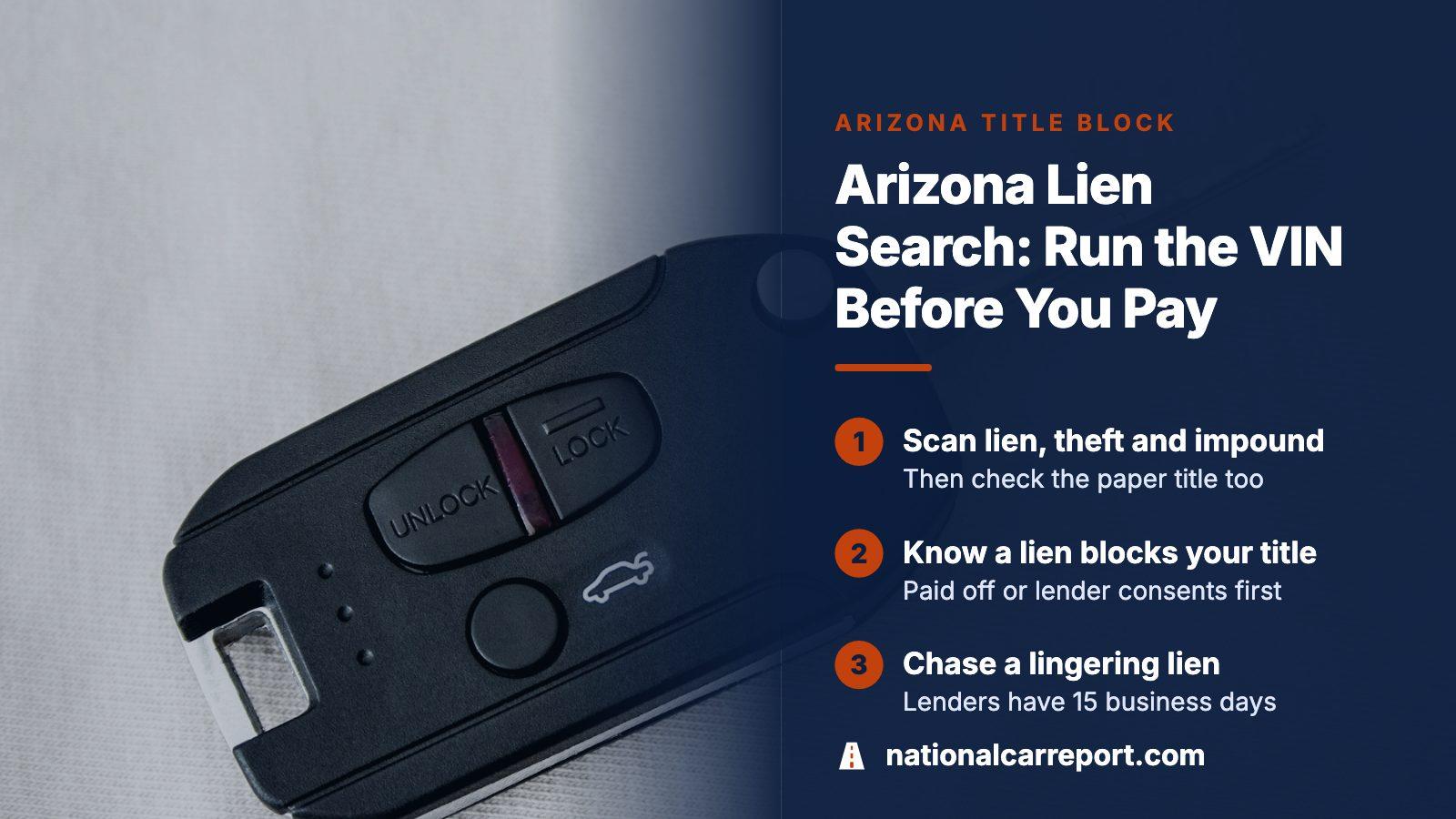
THE SHORT ANSWER
Read the VIN off the vehicle and put it through the free preview, which hunts for lien, theft and impound entries. If a lien appears, some lender could still hold a claim, and Arizona will not title the car to you until that claim is paid off or the lender agrees to the transfer. An empty result only screens; ask for the paper title as well.
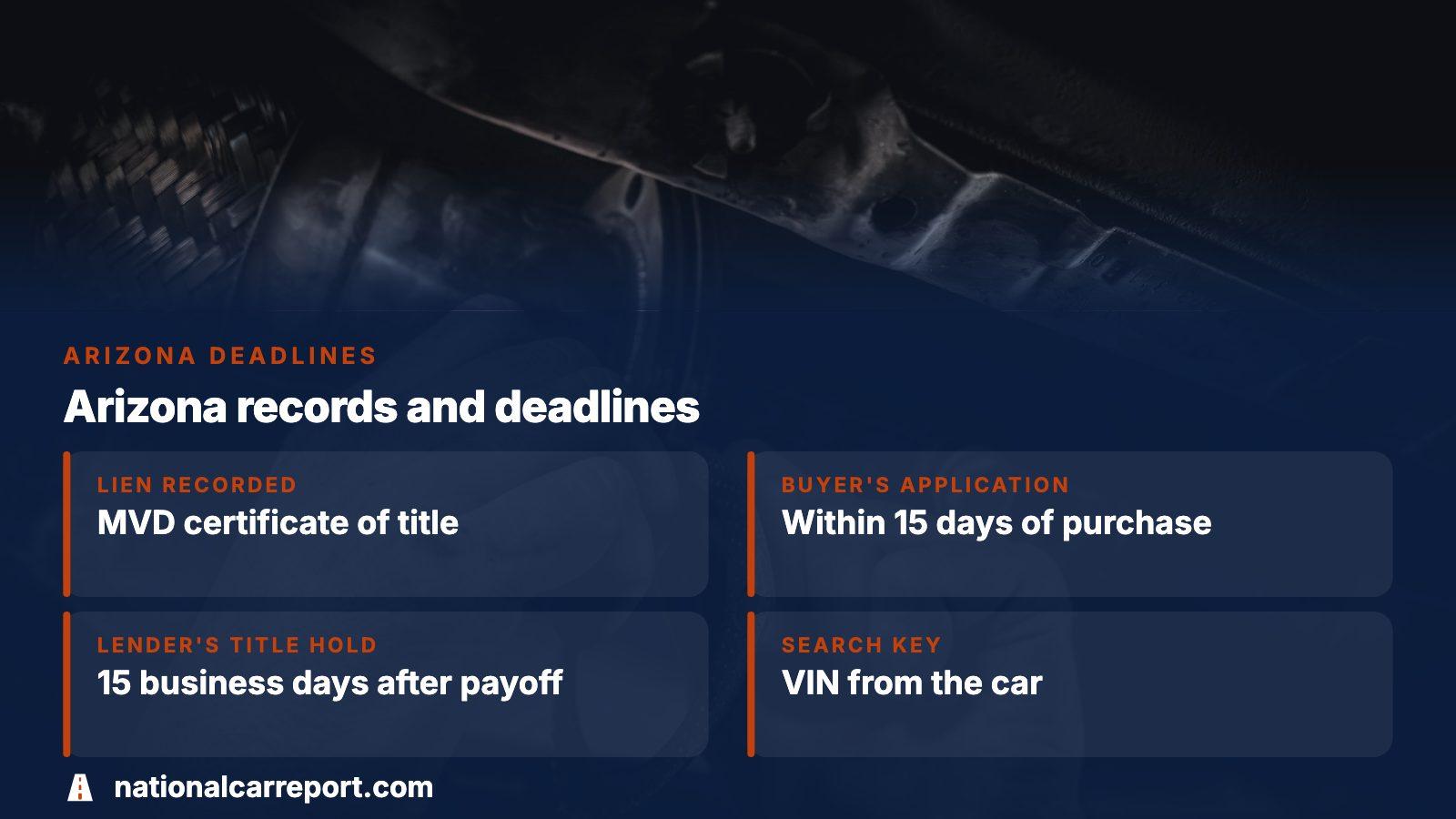
- Search key
- The VIN, read off the car itself
- Where Arizona records a lien
- The MVD's official certificate of title record
- Buyer's title application
- Due within 15 days of the purchase
- Lender's title hold after payoff
- 15 business days before a fine can apply
What an Arizona lien search turns up
NationalCarReport looks at a car from the side of the people who can claim it: a lender with a loan, a police department with a theft report, a tow yard with a car on the lot. All three attach to the VIN, so one search pulls together whatever was reported, in Arizona or in any state the car passed through.
- Liens: a lender's claim, shown where the detail was reported
- Theft: whether the car was reported stolen, and whether it came back
- Impounds: a record that the car sat in a tow or storage yard
- Title brands such as salvage, which often travel with a lien history
Nothing is charged for the preview itself. Buying the full report is a single payment; pack sizes are listed under pricing.
How Arizona puts a lien on a title
When someone finances a car, the title application carries a section just for the lender. By signing, the owner agrees (A.R.S. 28-2132) that the Motor Vehicle Division may display the lender on the state's official record of that car. The state also keeps an index of every lien filed under 28-2133.
The timing rule matters in a dispute. Paperwork that gets to an MVD office or authorized provider within 30 days of signing is treated as noticed from the signing date. Anything later counts from the day the MVD logged it. A late filing by a dealer, finance company or the MVD does not by itself cost the lender or the buyer the car.
Why a lien blocks the new title in your name
This is the part buyers miss. The same statute bars the MVD from issuing a fresh title while the old one carries a lien, unless the debt is settled or the lender approves the transfer in writing or electronically. A seller can hand you keys and a bill of sale, but the title in your name cannot follow until the lender steps aside.
What this means at the table
If the search or the title shows a lender, get the payoff arranged first. Best case, payoff and release happen in the same step, with the lender confirming it, before the seller sees the full price.
Running the search and checking the paper
- Find the VIN where the dash meets the glass and on the label inside the door frame; both should agree with the title.
- Run the VIN in the preview and note every lien, theft or impound line.
- Request the seller's signed title. If a lender's name appears, ask for the lender's written release or a payoff statement with a contact number.
- Match the owner named on the title to the seller's ID. A different name means stop.
- Apply for your own title within 15 days of the purchase.
Filing is the buyer's own duty under A.R.S. 28-2051, and every buyer named on the application signs. Licensed dealers get 30 days instead.

Reading each result and deciding what to do
| What you see | What it suggests | Your next move |
|---|---|---|
| A lien is listed | A lender recorded a claim that may still be open | Get a payoff figure and a release in writing |
| No lien shown | Nothing was reported to the databases searched | Inspect the title; the MVD record is the authority |
| Theft record, not recovered | The car may still count as stolen | Do not pay; tell police if you know where it is |
| Impound record | The car was held at a tow or storage yard | Ask who paid the fees and where it went next |
| Owner on the title is someone else | Whoever is selling may be unable to sign a release | Pause until the paperwork lines up |
| Seller claims it is paid off | The release may not have been recorded | Ask for the lender's release, not just a promise |
Why a blank result is not clearance
The federal title database, NMVTIS, is run under the Department of Justice. Its consumer report covers brands, the last odometer reading, what insurers decided about salvage or total loss, and sales to salvage yards. Liens do not appear on the list. DOJ adds that vehicles making up 87 percent of the fleet are in the system, a search can come back falsely clean, and a state's own title file holds more.
Treat the lien line as a warning light that only helps when it lights. When it stays dark, the Arizona title still needs a look. Pair a clear result with a signed title in the seller's name and a release if a loan ever existed.
When the loan is paid but the lien lingers
Some sellers swear the car is paid off while the title still names the lender. Arizona puts the burden on the lender, who must release the lien after payment in full and tell the owner at the title address. A lender holding the paper title for more than 15 business days after payoff can be fined by the MVD after a hearing: $50 if it is released within three more business days, another $50 per day past 18 business days, capped at $500 per title.
An owner who cannot locate the lender can ask the MVD to clear the lien, supplying proof of payment and an affidavit that describes the search. A lien still unsatisfied 12 years after filing can also be dropped from the records, but only for noncommercial vehicles and not for travel trailers, motor homes or mobile homes.
Other duties on a private sale in Arizona
At handover, the seller must sign over the title or a transfer form, including a warranty of title, and give it to you. The seller's registration expires on transfer, and the seller has 30 days to move the plates, surrender them or file a plate destruction affidavit. Until the MVD lists you as owner, the car needs a temporary tag, a permit or a valid plate on display.
Mileage disclosure applies too, with exemptions for older cars: ten model years for 2010 and earlier, twenty for 2011 and newer. Fees and current MVD processing times are not covered here, because the MVD's pages did not open for us. Check them with the MVD before you go.
What to do next
Run the preview on the VIN of the car you have been eyeing. If it lists a lien, theft entry or impound, you have a specific question for the seller before any deposit. If it is quiet, you still hold the title up against it. When the picture is worth buying, the full report costs one payment, and the pricing page shows how packs work.
Where this information comes from
- Arizona Revised Statutes 28-2132: indication of lien — Why a new title waits for a release or the lender's consent.
- Arizona Revised Statutes 28-2133: index and filing of liens — The lien index and the 30-day notice rule.
- Arizona Revised Statutes 28-2134: satisfaction of lien — Lender duties after payoff, the title-hold fine and the affidavit route.
- Arizona Revised Statutes 28-2136: unsatisfied liens — When the MVD may drop an old unsatisfied lien.
- Arizona Revised Statutes 28-2051: application for certificate of title — The buyer's filing window and what the application lists.
- Arizona Revised Statutes 28-2058: transfer of title — Seller's signature, plates and the odometer exemptions.
- Department of Justice: NMVTIS for consumers — What the national title system covers and where its gaps are.
Sources and photos: Facts checked against the sources above in November 2026. Photos by Shadow Photography, Jakub Żerdzicki and Martin Fennema on Unsplash; diagrams by NationalCarReport.
Keep reading
- Arizona Title Check: Six Steps to Run on a Used Car Before You PayThe state title side: brands, transfer rules and what the MVD record holds.
- Vehicle Lien Check by VIN: Nationwide Lien, Theft and Impound RecordsThe same lien step for a car from any state.
- DMV Lien Release Search: How to Confirm a Lien Is GoneHow to confirm a lender's release is real before you rely on it.
- PricingOne report or a pack, paid once, with no subscription.
Frequently asked questions
How do I do an Arizona lien search on a car?
Take the VIN from the vehicle and put it through the preview, which looks for lien, theft and impound records. Then get the seller's signed title and scan it for a lender's name. The Arizona MVD title record is the authority, so treat the search as a first screen.
Can I buy a car in Arizona that still has a lien?
You can, but the MVD will not issue a new title in your name while the old one shows a lien, unless the debt is satisfied or the lender consents in writing or electronically. Arrange the payoff and release at the same time you pay the seller.
The seller says the loan is paid, but the title still lists the lender. What now?
Ask for the lender's written release or a payoff letter. Arizona requires a lender paid in full to release the lien. If the lender cannot be found, the owner can ask the MVD to clear it with proof of payment and a sworn search affidavit.
Does a clear VIN search guarantee there is no lien?
No. Lien detail reaches national databases only where it is shared, and the federal title system does not list liens among its indicators. A clear result is useful, but the title and the MVD record settle the question.
How long do I have to put an Arizona title in my name?
A private buyer applies within 15 days of the purchase under A.R.S. 28-2051, and every buyer on the application signs it. Licensed dealers get 30 days. Start sooner if a lien must be released first, since that can take time.
Now check the car itself
The guide explains what to look for. The report shows what this VIN has on record.