THE SHORT ANSWER
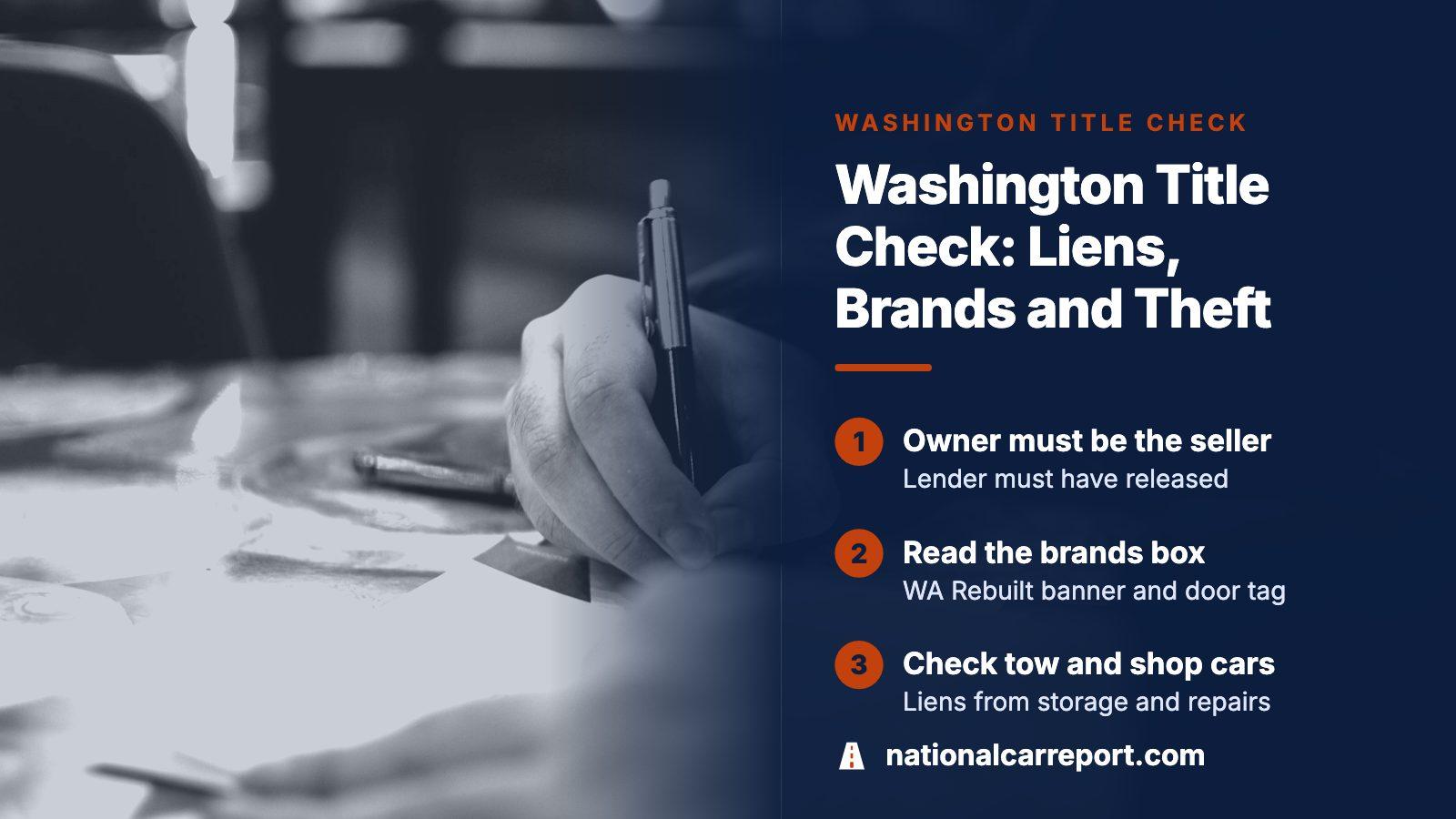
To check a Washington title, start with the document itself. The registered owner must be the person selling, any lender listed as legal owner must have released its claim, and the brands box must agree with the VIN's national history. Then run the VIN through theft, salvage and lien screens. Walk away if the title, the car and the report disagree.
- Owner name and address
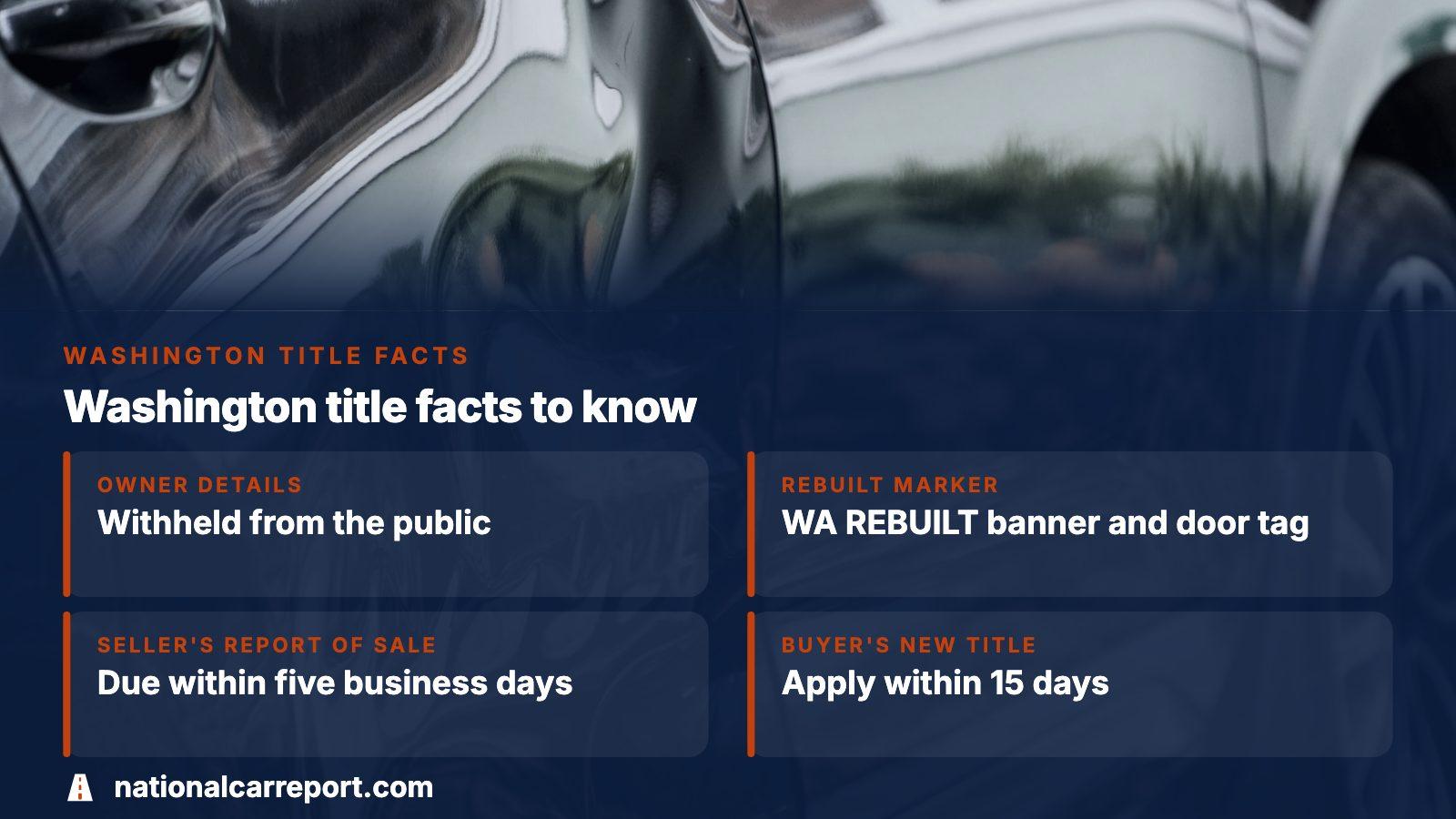
- Withheld from the public; business requests need a signed purpose
- Rebuilt marker
- WA REBUILT banner plus a tag at the driver's door latch pillar
- Seller's report of sale
- Due within five business days
- Buyer's new title
- Apply within 15 days of delivery
What a buyer can actually see in a Washington title search
Washington draws a firm line around owner data. The Department of Licensing gives an individual owner's name and address only to a business that files a signed request stating its purpose and agrees in writing to stay within it, at $2 per record. Full title history goes to a registered owner who says they are pursuing a claim under the state's new-vehicle warranty law. Neither route is built for a stranger about to buy a car.
That leaves two open sources: the title and registration the seller holds, and national records indexed by VIN. NationalCarReport works the second, setting theft, lien and impound entries beside the paper so each can be tested against the other.
Reading a Washington title, line by line
| Line on the record | What Washington prints | What to test it against |
|---|---|---|
| Registered and legal owner | Two roles, each with its own name and address | The seller's photo ID, and the lender if a loan is open |
| Mileage note | Actual, not actual, or exceeds mechanical limits | The dash reading and the report's odometer entries |
| Brands box | Washington brands first, then other states' unique brands, then standard ones | The report's brand history |
| Banner across the front | WA REBUILT, for a salvage car repaired and re-titled | The door latch pillar tag and any total-loss entries |
| Comments | Leased, bonded, duplicate, reprint | The seller's story; a duplicate means paper was replaced |
Washington brands stay on a record indefinitely, and DOL carries forward other states' labels, flood, hail and salvage-stolen among them. A 2010 or earlier model year skips the mileage statement at transfer, so older cars may change hands without odometer paperwork.
Why the seller may not have the title at all
DOL sends the registration to the registered owner and the title to the legal owner. While a loan is open the lender is the legal owner, so the paper sits in its file. A seller who says the title is at the bank is describing a normal financed car, and some cars carry only an electronic ownership record.
After payoff, the lender either routes the title to the owner through DOL or signs it straight over to the buyer, backed by the owner's release of interest. A lender that ignores a proper demand for ten days owes $100 to the owner or buyer who loses money as a result. Before paying on a financed car, hold these:
- A written payoff or release from the lender, showing the VIN.
- The seller's signature in the title's release section, or on an approved DOL form.
- A seller whose ID matches the registered owner's name exactly.
WA Rebuilt, and the older cars the brand never reaches
Washington wrecks get reported within 15 days, by the owner or, once a claim settles, by the insurer. A car that fits the salvage definition ends up with WA REBUILT across its title. Unless the owner at the time of the loss kept the car, a State Patrol inspection comes first, and it ends with a tag at the driver's door latch pillar that is a class C felony to remove.
The brand has a gap. When a car's model year trails the year of damage by six or more years, Washington calls it salvage only if its pre-damage retail value met a market value threshold, and only if the car is twenty years old or less. DOL's rule currently sets that threshold at $12,220, above the $6,790 statutory base, since it climbs with used-car prices. A ten-year-old sedan worth less can be wrecked, repaired and sold with no banner.
Age and price decide the brand
A spotless Washington title on a cheaper, older car proves less than it seems. If national data shows a total-loss record the title lacks, request repair invoices and have a mechanic check the frame and airbags.
Theft: what DOL screens and what is left to the buyer
For a car arriving from another state, DOL must screen it against police stolen-vehicle databases during the title application, and a hit stops the title. That protects the state's records. It does nothing for a buyer who hands over cash before any application exists.
Using FBI figures, the Washington Association of Sheriffs and Police Chiefs reports vehicle thefts rising from 24,726 in 2019 to 34,431 in 2024, up 39.25%, against 18.99% nationally.
A buyer who only wants a stolen status needs no State Patrol inspection: a commissioned officer at any police department or sheriff's office can check. National title data carries theft only in some cases, and an insurer may tag a stolen car left unrecovered for 30 days as a total loss. Washington's felony statute covers anyone who knows or has reason to believe a car is stolen, so a mismatched VIN means stop and phone the police.
Tow-yard, repair-shop and storage-unit cars
A tidy title can begin in a lien sale. A shop that was never paid can sell a car under a chattel lien, and a storage facility can sell a stored one over unpaid rent. DOL requires a court order in several situations, including a stored car with a lender already on record.
Ask the seller what paper brought the car to them. DOL accepts sale affidavits for abandoned vehicles, chattel and landlord lien forms, repossession affidavits and junk-vehicle certificates in place of an owner's release. Each is legitimate in the right setting, and each tells a story the report's impound and lien entries should echo.
The check in order, before the deposit
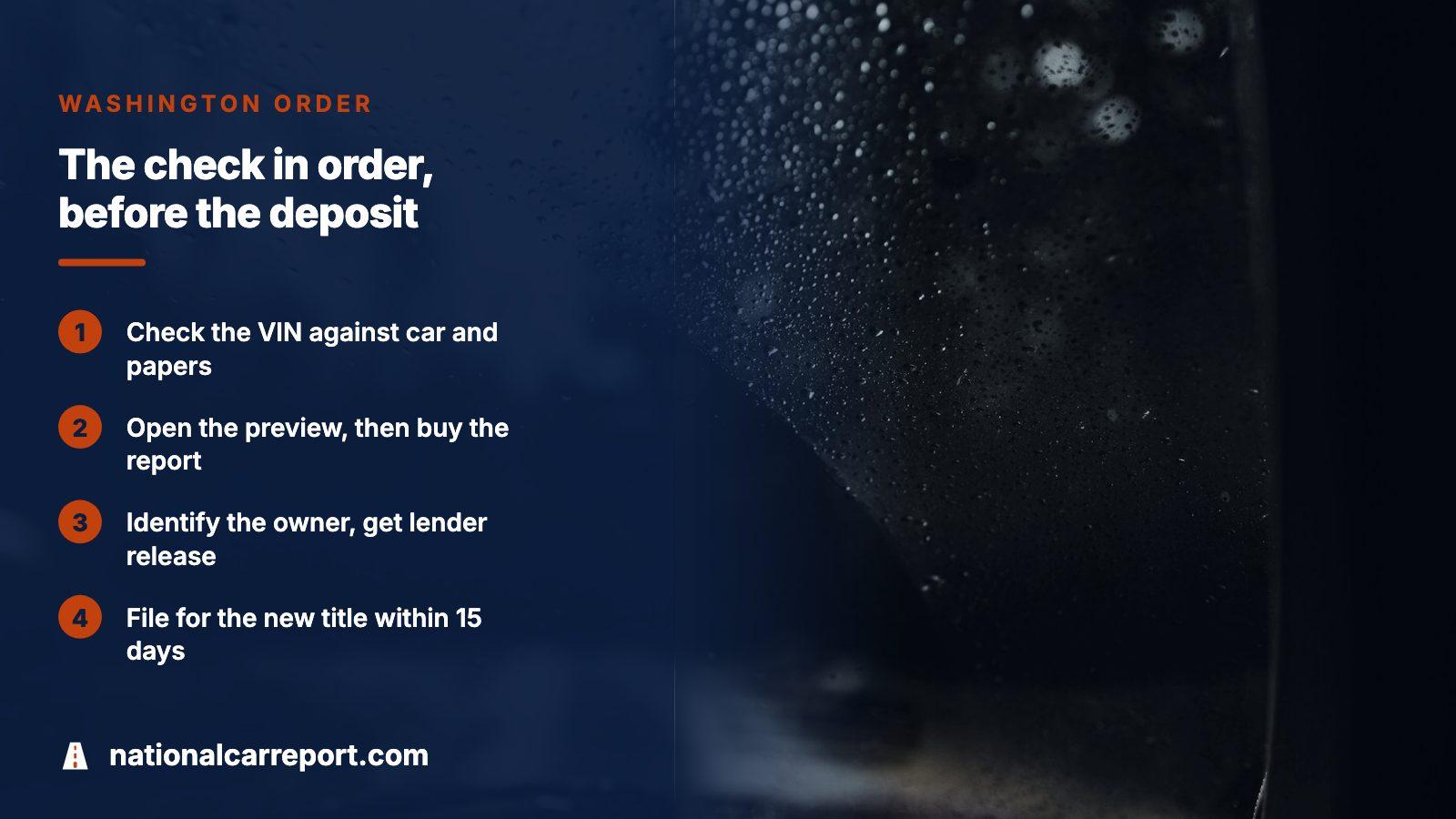
- Ask for the VIN ahead of the visit, then check it against the car, the title and the registration.
- Open the preview first and pay for the report once a car survives your first look. Set its brands, odometer entries, liens and theft records beside the title.
- Identify the legal owner. If a lender appears, get its release in writing, dated, with the VIN on it.
- Book a mechanic of your choosing for a pre-purchase inspection, as the FTC suggests.
- At the sale, sign the release section and odometer statement, keep a signed bill of sale, and make sure the seller files the report of sale within five business days.
- File for the new title inside 15 days of delivery. A late fee follows, and going past 45 days becomes a misdemeanor.
Walk-away signs
The registered owner is not the person selling. A lender is named but no release exists. The VIN differs between car, title and report. The report shows a brand that the title omits.
What the report costs and where it fits
The preview is free and shows whether a VIN has records worth opening. Payment is one-time: a lone report, or a bundle for shoppers weighing several cars, with no subscription to cancel. Amounts sit on the pricing page.
In Washington the report earns its place on what the title cannot settle: liens, theft and impound entries, plus brands and odometer readings from other states. The national title system covers 87 percent of vehicles nationwide, and state reporting is incomplete, so a clean result may mean only that no record was filed. Use the report as a cross-check, then inspect the car.
Where this information comes from
- Washington Legislature: RCW chapter 46.12, certificates of title — Sections on title contents, inspection, the stolen-vehicle search, total-loss reports, owner disclosure, release of interest and lender duties.
- Washington Legislature: RCW 46.04.514, salvage vehicle — Defines salvage and the age and value rule that leaves some older cars out.
- Washington Legislature: WAC chapter 308-56A, certificates of ownership — Brand list, the current threshold, accepted release papers, lien sales and replacement titles.
- Washington State Patrol: VIN inspections — Says who needs an inspection and that an officer can check stolen status.
- NMVTIS: information for consumers — What the national title system holds, its coverage and its false-negative warning.
- WASPC: Washington crime trends compared to national trends — Source for the 2019 and 2024 vehicle theft counts and rates.
- FTC: buying a used car from a dealer — Advice to pair a history report with an independent mechanic's inspection.
Sources and photos: Facts checked against the sources above in November 2026. Photos by Owen Michael Grech, Justin Cron and Maxim Tolchinskiy on Unsplash; diagrams by NationalCarReport.
Keep reading
- Vehicle Lien Check by VIN: Nationwide Lien, Theft and Impound RecordsWhat a lender's claim looks like on a record and how to prove a payoff.
- Stolen Vehicle Check in Washington State: Police, VIN and Lien RecordsThe Washington theft screen in detail, before any money moves.
- Seattle Impound Lookup: Find a Towed Car, Then Run a VIN CheckTracing a car through a Seattle tow lot and what that means for its paper.
- PricingReport and pack options, one payment, no subscription.
Frequently asked questions
Can I look up a Washington title by VIN online?
A buyer can read national records by VIN: brand history, odometer entries, theft and lien records. The state withholds an individual owner's name and address. The working pairing is the title in the seller's hands plus a VIN report.
How do I find out if a Washington car still has a lien?
Check who is named as legal owner, since the lender holds the title while the loan is open. A VIN report may show a lien, but only the lender can close it. Ask for a written release carrying the VIN; the seller's word that the loan is paid is not proof.
What does a WA Rebuilt brand mean?
It marks a salvage-level wreck that was repaired and passed a State Patrol inspection, which verified the VIN and where the major parts came from. The brand stays on the record for good, so value it as a rebuilt car and get the repairs inspected.
Is a clean Washington title proof the car was never wrecked?
No. Washington brands an older car as salvage only when its pre-damage value cleared the threshold, now $12,220, and damage nobody reported leaves no record at all. National data also has gaps. A clean title lowers the odds; an independent inspection closes the rest.
What if the seller has lost the Washington title?
A replacement goes only to the owner of record, on a notarized or certified request, and every legal owner on record must sign, the lender included. Let the seller obtain it before you pay. A replaced title voids every earlier copy.
Now check the car itself
The guide explains what to look for. The report shows what this VIN has on record.