
THE SHORT ANSWER
To run a Minnesota title check, compare the car's VIN against the title's VIN, character for character, read the lender and brand entries, and require a signed release from every lender named. Then screen the VIN against national theft, salvage and flood records and ask whether a tow lot ever held the car. Finish before paying, because the buyer's filing clock is 20 calendar days from assignment.
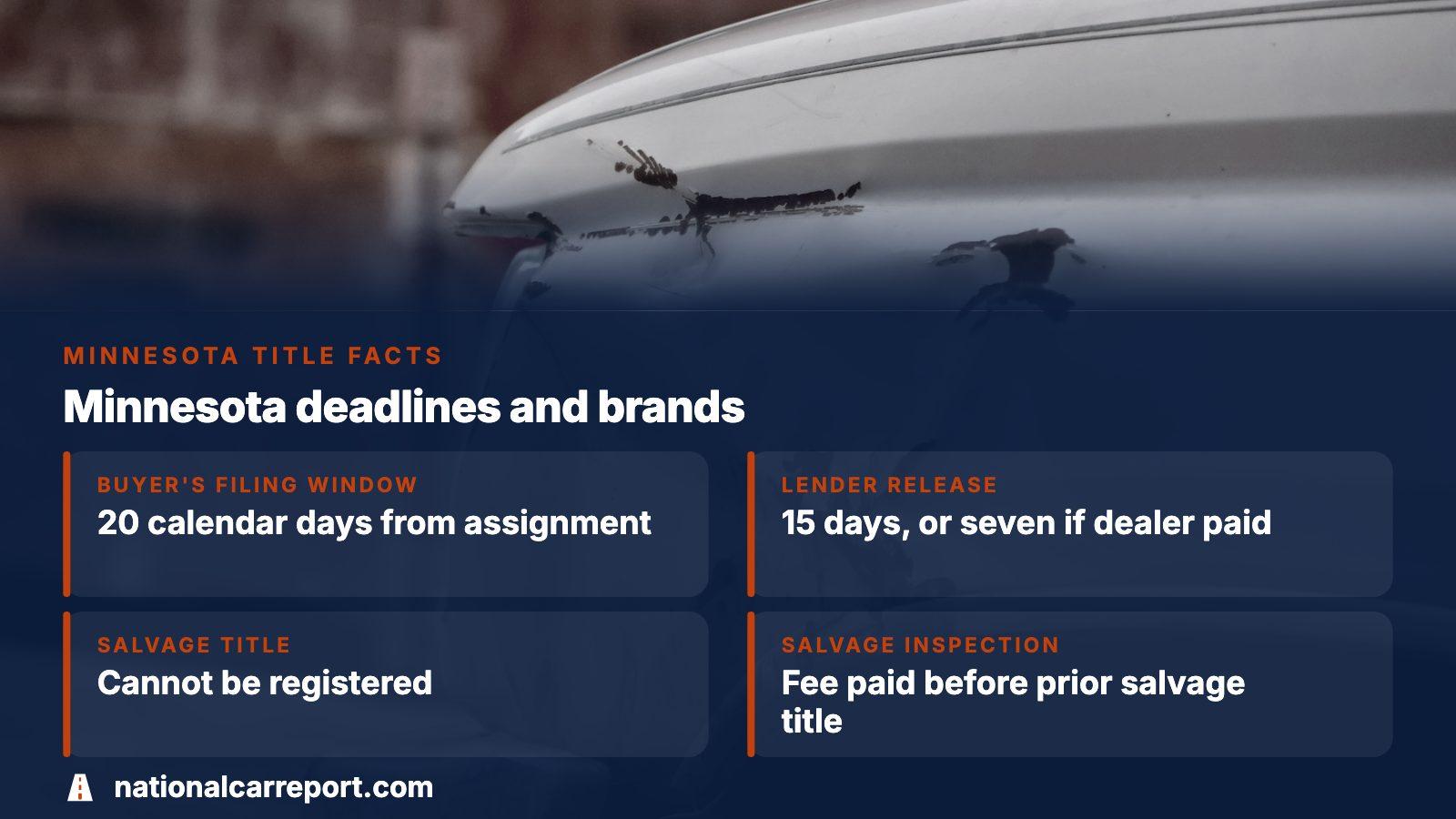
- Buyer's filing window
- 20 calendar days from assignment
- Lender release after payoff
- 15 days, or seven if a dealer paid
- Salvage title and plates
- A salvage title cannot be registered
- Salvage inspection fee
- $35, paid before a prior salvage title issues
The Minnesota check at a glance, in order
Cheap checks come first and paperwork last. A title records owners, lenders and brands, not open police files or tow-lot sales, so each step pairs a paper entry with the record that covers its blind spot.
- Compare the car's VIN with the title's VIN.
- Read the owner line, the lender line and the brand field.
- Get a signed release from every lender listed.
- Learn what the brand lets you do with the car.
- Screen the VIN against national theft, total-loss and flood records.
- Ask whether an impound lot ever held and sold the car.
- Finish the transfer inside the deadlines.
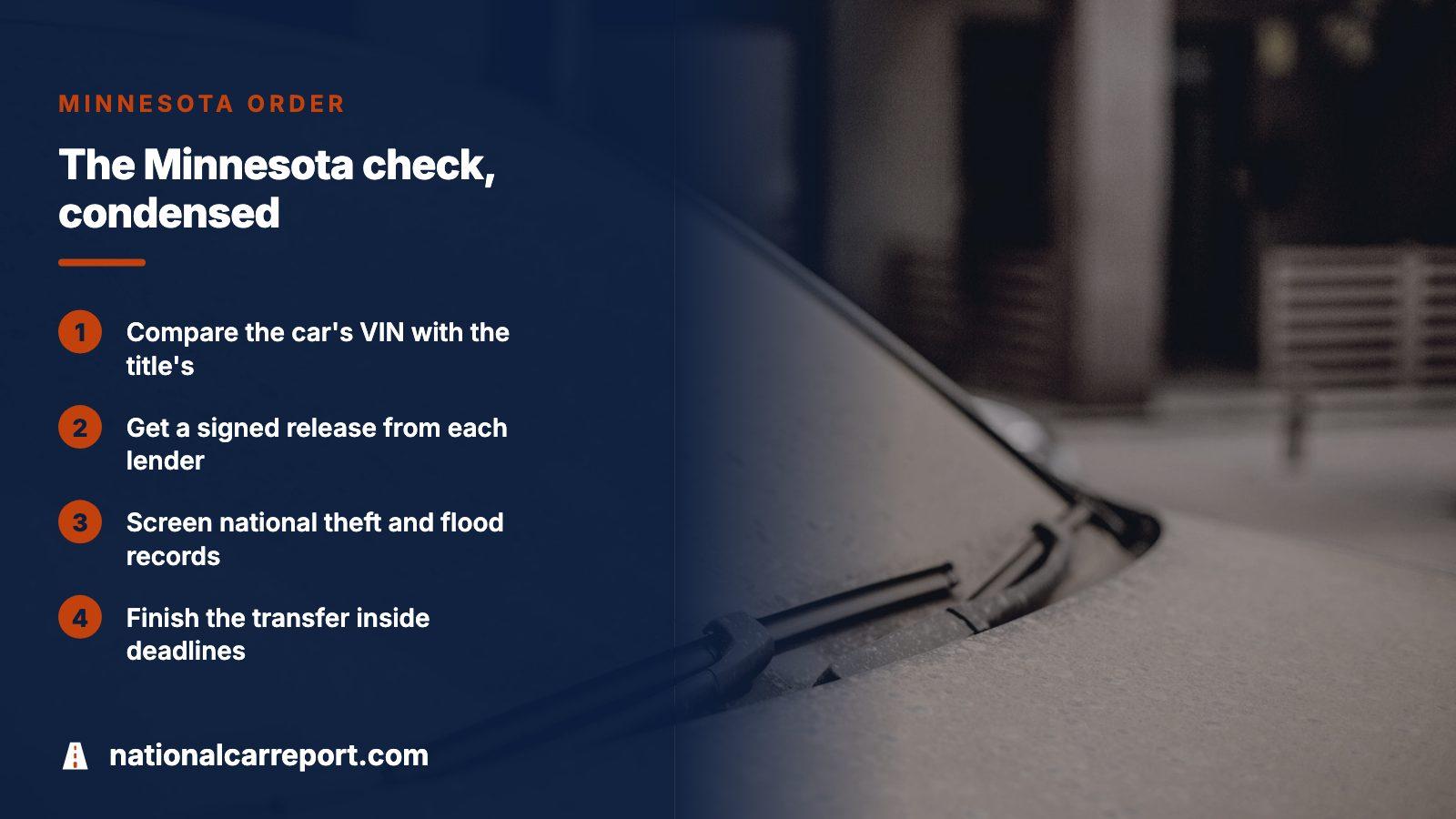
Steps 1 and 2: the VIN, the owner line and the lender line
Read the VIN off the vehicle, then the one on the title, one character at a time. Any mismatch ends the conversation. A Minnesota title carries owners, priority-ranked lenders, make, model and year, an odometer entry and any brands, so each line earns a slow read.
The owner line has to name the person selling to you, since only the titled owner can insure the car and an improperly transferred title blocks a later resale. An odometer entry reading unknown deserves a direct question.
What the title face leaves out
The statute's listed title contents do not mention open theft reports or impound sales. Steps 5 and 6 cover them.
Step 3: clear every lender before money moves
A lender named on the title still holds a claim. Minnesota's courts warn that an unpaid seller loan exposes the buyer to collection or repossession, and they say the lender's release should be attached whenever the title shows one.
A lender gets 15 days after payoff to sign off and forward the release, or seven days if a licensed dealer settled the loan. Because that clock starts at payoff, ask for confirmation of payoff and the release together, in writing.
- One signed release per lender, names matching the title face.
- Payoff proof dated before the title changes hands.
- Title and release handed over together.
A second pair of eyes at the counter
The courts suggest closing the sale at a Driver and Vehicle Services location, where an agent can review the title for liens.
Step 4: what each Minnesota brand allows
Brands stand out on the title and follow the car onto every later one. For a write-off, salvage versus prior salvage turns on the car's class, not on a scale of damage. Late-model means a model year from five calendar years back or newer, so 2021 and up in 2026. High-value mostly means over $9,000 in cash value before the damage.
| Brand | Trigger | Consequence |
|---|---|---|
| Salvage | An insurer paid out on a vehicle in the newer or pricier class defined above, or a buyer took in a damaged one | Can be held, hauled and sold, never registered |
| Prior salvage | Insurer-owned car outside that class, or a damaged car once branded salvage or rebuilt, even by another state | Salvage history on record; a late-model or high-value car reaches it only after an inspection |
| Flood damaged | A water total loss, or an earlier flood brand | Carried on every later title |
| Reconstructed | Essential parts removed, added or swapped | Carried on every later title |
Two rarer brands exist: lemon law vehicle, and hazardous waste contaminated vehicle for cars tied to methamphetamine production. A car declared unrepairable gets a junking certificate, which allows little beyond possessing and transporting it.
Step 5: screen national theft, total-loss and flood records
The title shows only what Minnesota recorded. NICB's VINCheck takes a 17-digit VIN and looks for insurer reports of unrecovered theft, salvage and flood damage, capped at five lookups in 24 hours per IP address. Its member insurers represent 92.49 percent of the country's earned premium, yet it holds insurance records only and never queries police files.
The Justice Department's NMVTIS adds other states' brands, the latest odometer reading and salvage-yard transfers. It holds 87 percent of vehicles, but reporting among states is incomplete, so a result showing no history may simply be missing data.
- Theft total loss: an insurer may write off a car missing for 30 days, and the label survives a safe recovery.
- Cloning: about 250 stolen cars recovered in Operation Roadrunner wore VINs taken from matching vehicles, so an online match still has to agree with the car itself.
- Washed brands: Minnesota requires prior salvage when a buyer takes in a damaged car that any other jurisdiction ever branded salvage.
Step 6: rule out a tow-lot sale in the car's past
A car can pass through an impound lot and surface in a classified ad with tidy papers. The towing agency or lot must mail notice within five days, skipping weekends and holidays, to the owner and every lienholder of record. That notice starts these clocks.
| Situation | Earliest sale |
|---|---|
| Junk or abandoned vehicle | 15 days after notice |
| Other unauthorized tow, outside Minneapolis and St. Paul | 45 days after notice, or sooner if the owner signs the title over to the lot |
| Unauthorized tow by Minneapolis or St. Paul | 15 days after certified mail; 45 if the owner or a lender states in writing that it will reclaim |
Ask the seller whether the car was ever towed, who paid storage and how the title arrived. A tow-lot sale is not disqualifying alone, but a shifting account is. The courts also warn that a title still held by a seller with a drunk-driving record could end in a state impound and sale.
Step 7: the transfer paperwork and its deadlines
- Seller at delivery: a signed assignment and warranty of title, the actual price, the odometer statement, and the title itself.
- Seller within ten days: a Notice of Sale, unless a licensed dealer is part of the sale.
- Seller liability: it ends after delivery if the seller's steps are done within 48 hours.
- Buyer: the application for a new title within 20 calendar days of assignment, or the registration is suspended.
Disclosure rides along. A seller who knows the repair cost topped 80 percent of the car's cash value before the damage must say so in writing on the transfer papers. Dealers also owe a written notice, signed by the buyer, of any brand they know of and of flooding above the bottom of the dashboard on their lot.
Plates stay with the car in Minnesota. Fees and forms change, so confirm current amounts with Driver and Vehicle Services.
Where the preview and the report fit
Try the VIN preview first; it costs nothing and shows what exists. A full report costs one payment, and no renewal follows. Packs of 3, 5 or 10 are there for shoppers weighing several Minnesota cars. Pricing sits on its own page, and the sample report lets you see how an entry reads.
Here the report earns its place through theft, impound and lien entries beside brands and odometer readings. It replaces neither the lender's release nor the title. Run the VIN before the deposit and walk away from a car whose title and VIN disagree.
Where this information comes from
- Minnesota Statutes chapter 168A: certificates of title — Source for title contents, salvage and prior salvage rules, the $35 inspection fee, transfer deadlines and lien releases.
- Minnesota Statutes 325F.6641: disclosure of vehicle damage — Explains the 80 percent damage statement and the dealer's written and flood disclosures.
- Minnesota Statutes 325F.6642: title branding — Covers when the flood damaged, salvage, prior salvage and reconstructed brands are recorded.
- Minnesota Statutes chapter 168B: impounded vehicles — Gives the notice duty and the waiting periods before an impounded car can be sold.
- Minnesota Judicial Branch: car title problems — Buyer risks from a seller's unpaid loan, the lien release and the tip to finish at a DVS office.
- Department of Justice: NMVTIS for consumers — Describes what the national title system holds, its coverage gaps, the total-loss label and cloning.
- NICB: VINCheck — Free insurer-reported theft, salvage and flood screen, with its search limit and what it leaves out.
Sources and photos: Facts checked against the sources above in November 2026. Photos by Scott Graham, JavyGo and Everett Pachmann on Unsplash; diagrams by NationalCarReport.
Keep reading
- Vehicle Lien Check by VIN: Nationwide Lien, Theft and Impound RecordsHow a lender's claim shows up and how to confirm a payoff.
- Stolen Car Check by VIN: Nationwide Theft, Lien and Impound RecordsTheft records for any car, and what a recovery leaves on the file.
- Minneapolis Impound Lookup: Find a Towed Car, Then Check Its VINFinding a car held in the Minneapolis lot, and what to ask afterward.
- PricingOne report or a pack, paid once, with no subscription.
Frequently asked questions
How do I do a Minnesota title search?
Compare the title with the car, read the lender and brand entries, and ask each lender for a signed release. Then run the VIN through NICB VINCheck and NMVTIS for theft, salvage and flood history. A Driver and Vehicle Services office can review the title for liens at closing.
Is there a free Minnesota title check?
Parts of one. The preview is free, and NICB's VINCheck costs nothing within its daily limit of five lookups. VINCheck holds insurance records only, so it cannot confirm a lender's claim. The title, a lien release and a full history report finish the job, and that report is its own purchase.
How long do I have to title a car I bought in Minnesota?
Twenty calendar days from the moment the seller assigns the title, or the registration is suspended. A private seller owes the state a Notice of Sale within ten days. Check current forms and fees with Driver and Vehicle Services before filing.
Can I register a Minnesota car with a salvage title?
No. A salvage title lets you possess, transport and transfer the car, never plate it. A late-model or high-value car moves to prior salvage after an inspection with a $35 fee. A car outside that class is branded prior salvage from the start when an insurer writes it off.
How do I find out if a Minnesota car still has a lien?
Lenders appear on the title in priority order, so view the whole title face and request a release from each name. A lender must release within 15 days of payoff, or seven if a dealer paid. A VIN report can add lien entries, but only the release settles it.
Now check the car itself
The guide explains what to look for. The report shows what this VIN has on record.